
The phenomenon of Christian prayer represents an intricate intersection of theology, anthropology, and spiritual discipline. It is defined fundamentally as a heartfelt conversation with the Divine, an act that has been observed in various forms from the initial interactions of Adam in the Garden of Eden to the eschatological petitions for the return of Christ in the Book of Revelation.
In the Christian tradition, prayer is not merely a cognitive exercise but a sanctifying skill that matures through consistent practice and the operation of grace. The theological mandate for prayer is rooted in the life of Jesus Christ, who modeled a life of constant communication with the Father, frequently withdrawing to mountains or solitary places to pray for extended periods. This analysis examines the multifaceted nature of prayer, categorizing it through its structural models, levels of interiority, communal functions, and historical traditions across the Orthodox, Catholic, and Protestant families of faith.
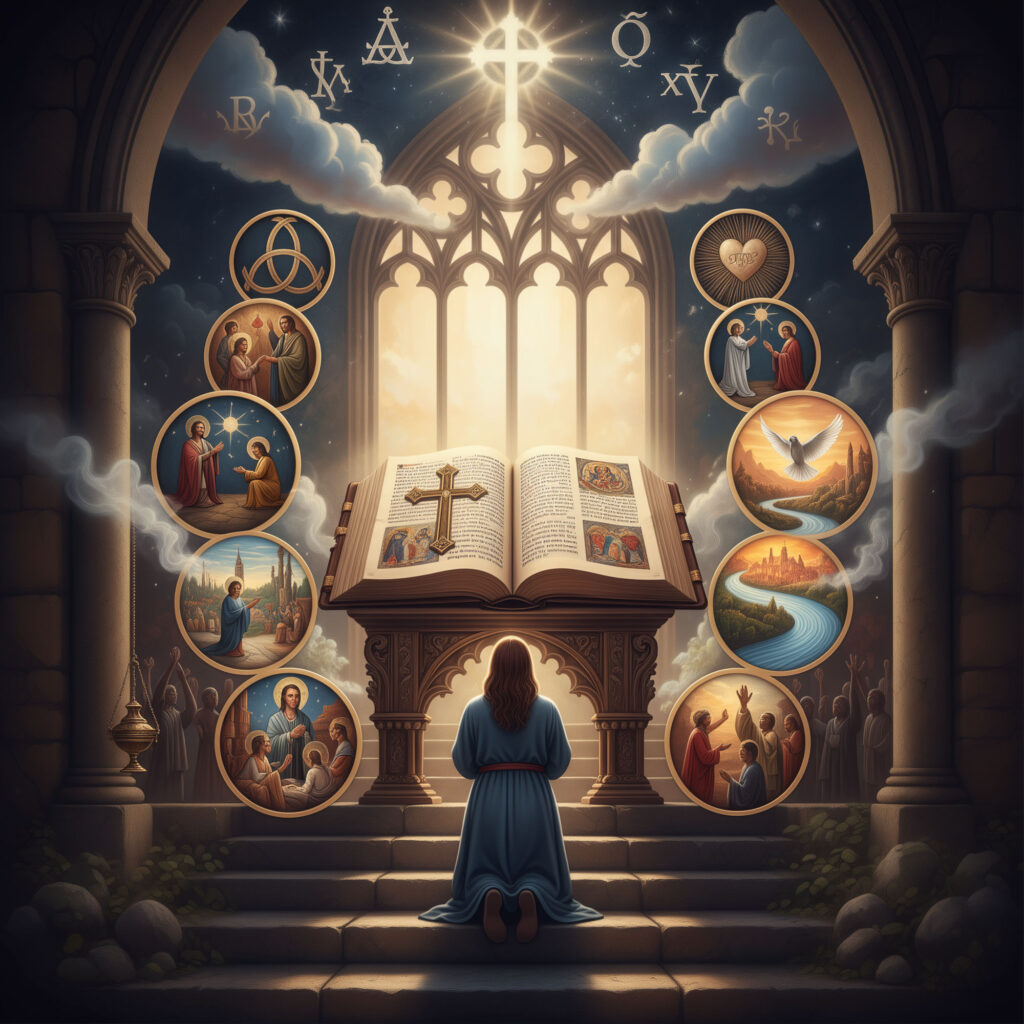
The ACTS model provides one of the most widely utilized pedagogies for structuring personal and communal prayer in contemporary Protestant and Evangelical traditions. Although the acronym itself is a modern mnemonic device rather than a direct biblical reference, its components are deeply rooted in the liturgical and scriptural patterns found in the “Lord’s Prayer” (Matthew 6:9-13) and the Pauline epistles. The model seeks to balance personal needs with a healthy dose of worship and thanksgiving, ensuring that the prayer life of the believer does not become exclusively self-centered.
Adoration serves as the essential starting point of the ACTS framework, focusing on the inherent nature, character, and attributes of God rather than His actions or the petitioner’s needs. This phase of prayer acknowledges the greatness, holiness, and majesty of the Creator. By prioritizing adoration, the individual intentionally displaces the self from the center of the spiritual encounter, aligning their perspective with divine reality.
Theologically, adoration is justified by the intrinsic worthiness of God as the Maker of the universe, the Alpha and the Omega, and the giver of all good things. Biblical examples include the “Holy, Holy, Holy” of the angelic hosts in Isaiah or the exultant praise found in the Psalms, such as Psalm 95:1-6 or Psalm 150. It often employs scriptural titles, such as Emmanuel or Prince of Peace, to ground the emotional experience of worship in revealed truth. Adoration functions as a psychological and spiritual recalibration; when the believer contemplates the omnipotence and mercy of God, their own anxieties are placed within a larger, more secure context.
Confession follows adoration in the ACTS model, acting as a searching prayer of the heart regarding personal sins and shortcomings. This practice is based on the promise found in 1 John 1:9, which asserts that if sins are confessed, God is faithful and just to forgive and purify the believer from all unrighteousness. Theologically, confession is not about earning salvation, which is viewed as a finished work of grace through the blood of Christ, but about restoring the relational intimacy between the child and the Father.
A nuanced understanding of confession suggests that it serves a vital cathartic function, allowing the believer to receive forgiveness and move forward without the weight of past failures. The sequence of the model is significant: because the believer has first contemplated God’s might, power, and compassion in the adoration phase, the subsequent confession does not feel heavy or despairing. Instead, it becomes a burden taken off the shoulders and laid at the feet of Jesus. Practitioners are encouraged to move beyond vague apologies toward a specific examination of conscience, addressing impatience, wasted time, or misaligned identities.
While adoration focuses on who God is, thanksgiving focuses on what God has done, is doing, and will do. This distinction is critical in Christian theology. Thanksgiving is an active recognition of God’s provision, protection, and salvation in both the macroscopic and microscopic details of life. The mandate for this type of prayer is found in 1 Thessalonians 5:18, which instructs believers to give thanks in all circumstances, recognizing this as the will of God in Christ Jesus.
Practicing thanksgiving serves to soften the heart and foster trust, particularly during seasons of suffering or uncertainty. It often covers categories such as physical needs (food, shelter), relational blessings (family, friends), and spiritual gifts (forgiveness, an eternal home). The model encourages identifying specific instances of grace, such as a timely song on the radio or the beauty of creation, to train the mind toward a perspective of abundance rather than scarcity.
Supplication represents the final element of the ACTS model, characterized by earnest and humble requests made to God. This category is often subdivided into petitions, requests made for one’s own needs, and intercessions, requests made on behalf of others. It is rooted in the biblical invitation to “present your requests to God” with the promise that the peace of God, which transcends understanding, will guard the heart (Philippians 4:6-7).
The theology of supplication emphasizes that God is a loving Father who delights in giving good gifts to His children, much as a human father provides bread rather than a stone. Rather than treating God as a transactional entity, supplication is an act of dependence that acknowledges God as the ultimate source of all provision. Persistence in supplication is encouraged not to gain God’s attention through volume, but to faithfully give concerns to Him while waiting on His timing and sovereign will.
| Component | Focus of the Prayer | Core Scriptural Basis | Theological Objective |
|---|---|---|---|
| Adoration | God’s Character and Attributes | Psalm 95:1-6, Revelation 4:11 | Recognizing Divine Sovereignty |
| Confession | Repentance of Specific Sins | 1 John 1:9, Psalm 51 | Relational and Moral Restoration |
| Thanksgiving | Gratitude for God’s Actions | 1 Thess 5:18, Psalm 103:1-4 | Cultivating a Grateful Disposition |
| Supplication | Personal Needs and Intercession | Phil 4:6-7, Matthew 7:7-11 | Demonstrating Absolute Dependence |
Beyond the ACTS model, the biblical text reveals a rich diversity of prayer types, each serving a distinct purpose in the spiritual life of the individual and the community. These forms reflect the various situational needs of humanity in relation to the Divine.
A prayer of worship focuses exclusively on who God is, recognizing His power, majesty, and glory. It involves acknowledging His name and His created works, as seen in the liturgical cries of Revelation 4:11, where God is declared worthy to receive glory and honor. While closely related to thanksgiving, worship is distinguished by its focus on God’s identity rather than His specific benefits to the individual. This form often takes the shape of singing praise songs or offering the “fruit of lips” that acknowledge His name, as described in Hebrews 13:15.
Praying in faith involves a reaffirmation of trust in God’s will, conceding that His purposes should be done rather than enforcing the petitioner’s will upon the Divine. This type of prayer is particularly associated with healing and the effective intervention of the righteous, as noted in James 5:13-16. Closely allied is the prayer of consecration, used to set something or someone apart as holy. A primary example is the prayer offered during communion, where God is asked to make the bread and wine holy, following the example of Jesus at the Last Supper in Matthew 26:26-27.
Intercession is the act of praying on behalf of another person or group, seeking their well-being before the Lord. A definitive biblical example is found in Daniel 9, where the prophet intercedes for the people of Israel, confessing their collective sins and pleading for restoration based on God’s great mercy rather than the people’s righteousness. Fellowship prayer, often considered one of the highest forms, focuses on enjoying and purposefully spending time with God for the sake of relationship and intimacy. This involves a “longing for” the presence of the Divine and may not always involve talking, but rather “being together” in a shared life of love.
When a believer does not know exactly what to pray for or how to articulate their needs, the Bible describes the prayer of the Holy Spirit. According to Romans 8:26-27, the Spirit helps the believer in their weakness, interceding with “wordless groans” that are in accordance with the will of God. This theology suggests that prayer is a cooperative effort between the human heart and the Divine Spirit, ensuring that even in moments of profound confusion or despair, the petitioner’s needs are accurately presented before the Father.
| Prayer Type | Scriptural Reference | Central Purpose |
|---|---|---|
| Worship | Revelation 4:11 | Recognizing God’s Glory |
| Faith | James 5:13-16 | Trusting God’s Will for Healing |
| Intercession | Daniel 9:1-27 | Pleading for the Well-being of Others |
| Consecration | Matthew 26:26-27 | Setting Objects or Lives Apart for God |
| Fellowship | Ephesians 6:18 | Cultivating Intimate Relationship |
| Holy Spirit | Romans 8:26-27 | Divine Intercession in Human Weakness |
In broader Christian theology, particularly within the Catholic and Orthodox traditions, prayer is often categorized by its level of interiority and the human faculties involved. The Church recognizes three major expressions of prayer, vocal, meditative, and contemplative, which are often viewed as a hierarchy of increasing intensity and spiritual depth.
Vocal prayer is the most common form, involving the association of the body with the interior prayer of the heart. Theologically, the importance of vocal prayer corresponds to the requirement of human nature as both body and spirit; humans feel the need to translate internal feelings externally through the senses. By speaking words, prayer “takes flesh” and allows the whole being to participate in the act of homage.
Jesus Himself modeled vocal prayer, raising His voice in exultant blessing and in the agony of Gethsemane. The “Our Father” is considered the perfect form of vocal prayer, providing a structure that acknowledges relationship, divine transcendence, and specific petitions. While vocal prayer is the initial form of contemplative prayer, it is not determined by the number of words but by the fervor of the soul and an awareness of the One being addressed.
Meditation is characterized as an active mental prayer and a prayerful reflection that begins with the Word of God in the Bible. It engages thought, imagination, emotion, and desire to deepen faith and fortify the will to follow Christ. This form of prayer is often described as a “quest” where the mind seeks to understand the “why and how” of the Christian life.
Practitioners utilize various aids for meditation, including Sacred Scripture, holy icons, writings of spiritual fathers, and the “book of creation”. The ultimate goal of meditation is not merely intellectual understanding but the development of a union of love with God and one’s neighbor. St. Padre Pio noted that meditation is a necessary practice for spiritual growth, suggesting that if one struggles with distractions, they should persevere in a “meditation on patience”.
Contemplative prayer is the summit of the life of prayer, described as a “simple gaze upon God in silence and love”. It is a gift of God and a moment of pure faith during which the individual surrenders themselves to the loving will of the Father and the action of the Holy Spirit. St. Teresa of Avila defined it as an “intimate sharing of friendship” where one takes time to be alone with the God who loves them.
Unlike meditation, which involves active mental effort, contemplation is characterized by a “prayer of quietude” and a receptive stillness. It requires discipline and consistent time set aside daily to foster an openness to grace. Contemplation is often practiced in quiet settings like a parish church or a chapel of Eucharistic Adoration, where the absence of distractions allows for a deep, wordless reflection on the presence of Christ.
| Expression | Faculty Engaged | Primary Methodology | Theological Goal |
|---|---|---|---|
| Vocal | Lips, Body, Voice | Spoken Formulas (e.g., Our Father) | Externalizing Heart-Prayer |
| Meditative | Mind, Imagination, Emotion | Reflection on Scripture (Lectio Divina) | Understanding and Conversion |
| Contemplative | Spirit, Will, Silence | Wordless Gaze, Stillness | Union and Friendship with God |
A fundamental distinction in Christian spirituality exists between liturgical prayer, the public prayer of the Church, and private devotional prayer. This differentiation is not based on the number of participants or the location, but rather on the intent, identity, and theological function of the prayer.
Liturgical prayer is defined as the prayer of Christ through His Church for the world. Whenever the faithful gather around the scriptures or celebrate the Eucharist, they are entering into the eternal prayer and sacrifice of Christ. This form of prayer is an instrument of salvation for the world rather than a self-focused activity. It includes the Divine Office (Lauds and Vespers), which can be prayed in community or privately by clergy and laity alike.
By virtue of baptism, adults are seen as having a commitment to habitually pray for the world through these liturgical forms. Liturgical prayers are typically formal, concisely written, and theologically consistent, often drawing from ancient texts like the Book of Common Prayer or the Roman Missal. They serve to educate the faithful, moving them beyond subjective desires to ask God for things according to His Spirit.
Private or devotional prayer, regardless of whether it is done individually or in a large group, has the single aim of drawing the individual into deeper intimacy with Christ. It seeks to open the heart so the individual can hear God’s personal declaration of love. Common forms include meditation, the rosary, and various spontaneous prayers.
While liturgical prayer is the official “Office” of the Church, devotional prayer is more flexible and can be “customized” to the individual’s spiritual state. However, spiritual writers caution against confusing the two; if a person finds the liturgical ritual a hindrance to their desired private devotion, they risk doing both poorly. Both forms are interdependent; liturgical prayer is most vibrant when those participating are also people of private prayer.
While sharing a common heritage, the Catholic and Eastern Orthodox traditions have developed distinct physical and structural aids for prayer, most notably the Rosary and the Prayer Rope.
The Western Rosary is a highly structured devotion organized around the meditation of the “Mysteries”, specific biblical events in the lives of Jesus and Mary. It consists of beads arranged in five decades, where each decade includes ten Hail Marys preceded by an Our Father and followed by a Glory Be. The physical beads provide a tangible goal and a clear format, reducing the mental effort required to structure the prayer session.
The Rosary serves as both a petitionary tool and a means of thematic contemplation. Catholics view Mary as the most efficacious way to union with God, asking her to intercede and bring their prayers to Christ. The vocal prayers act as a rhythmic “background” while the mind focuses on the theological mysteries, such as the Joyful, Sorrowful, Glorious, or Luminous events.
The Eastern Orthodox tradition is famously associated with the Jesus Prayer: “Lord Jesus Christ, Son of God, have mercy on me, a sinner”. This is practiced using a prayer rope (komboskini or chotki), which is typically a loop of wool knots. The wool construction allows for silent prayer, unlike the clicking of beads, reflecting the Eastern emphasis on inner quietude (Hesychia).
The spiritual focus of the Jesus Prayer is repentance, humility, and achieving a continuous connection with God. It is designed to be flexible, used by beginners and monastics alike at any time or place, walking, traveling, or working. Unlike the structured sequence of the Rosary, the Jesus Prayer involves the rhythmic repetition of a single phrase to achieve spiritual alertness and lead the practitioner into the deeper mysteries of the contemplative life.
| Feature | Roman Catholic Rosary | Eastern Orthodox Prayer Rope |
|---|---|---|
| Physical Tool | String of Beads (wood, glass, stone) | Loop of Wool Knots |
| Count | Usually 50 beads (5 decades) | 33, 50, or 100 knots |
| Prayer Pattern | Structured sequence of various prayers | Rhythmic repetition of a single prayer |
| Mental Focus | Thematic Meditation on the “Mysteries” | Inner Stillness and Continuous Awareness |
| Primary Theme | Intercession and Christological Scenes | Repentance and Reliance on Grace |
Pentecostal and Charismatic spirituality is characterized by an emphasis on the immediate experience of the Holy Spirit, often manifesting in spontaneous and emotionally expressive prayer forms.
“Praying in the Spirit” is a central concept, frequently interpreted in these traditions as the use of the spiritual gift of speaking in tongues. This is viewed as a form of private devotional prayer where the Spirit intercedes for the believer, providing a way to praise and thank God when human words are insufficient. Practitioners believe it produces health in the body and mind, serves as a weapon in spiritual warfare, and fosters a deep communion with God.
While some theologians argue that tongues were primarily an evangelistic tool for speaking human languages (as in Acts 2), the Pauline description in 1 Corinthians 14 identifies it primarily as a means of communicating with God in supplication and intercession. It is viewed as a “heavenly language” that must be nurtured and “fanned into flame” through regular use.
Corporate prayer in Pentecostal settings is rarely quiet and often marked by simultaneous participation. In “Korean-style” prayer, the entire congregation prays aloud together at the same time, creating a “swell of prayer” that fosters a sense of unity in the community. This practice is seen as a way of giving voice to the different but harmonious prayers of the group, guided by a leader who sets the initial direction.
This type of prayer is often accompanied by “groanings” or loud cries, mirroring the intensity of Jesus’ own prayers in Hebrews 5:7. The objective is to move beyond the “independent soul” to become a vessel for the Holy Spirit’s power. While spontaneous, this prayer is often purposeful, focusing on “great boldness” or “signs and wonders” in alignment with the mission of the early church described in Acts 4.
Lament is a specific biblical form of prayer that allows the faithful to take their sadness, anger, disillusionment, and despair directly to God. It is an act of refusal to rationalize or dismiss the harsh realities of suffering, instead carving out a sacred space to confront them.
Biblical laments, particularly in the Psalms, often follow a general pattern that provides a pathway out of discomfort toward hope :
Lament remains a powerful tool for modern believers to process grief, betrayal, and systemic injustice. It has been used to address personal trauma and collective issues, such as the death of Sandra Bland or the displacement of ancient cultures in Australia. Practitioners are encouraged to be unpolished and honest, avoiding the tendency to “side-step” tough times. The practice of lament is viewed as an exercise in hope, as it acknowledges the fractures of the world while waiting for the return of Christ when all things will be made right.
For those seeking to deepen their interior life, various structured methodologies have been developed to facilitate a personal conversation with God through scripture and daily experience.
Lectio Divina is a powerful way to pray with the Bible, focusing on conversational intimacy rather than intellectual research. The process involves four key steps or “underlying rhythms” :
Some traditions add a fifth step, Incarnatio, which involves living out the word in daily life. This method is especially effective for small groups, as it helps members remain vulnerable and emotionally connected to God and one another.
The Examen is a technique for detecting God’s presence and discerning His direction in the ordinary moments of life. St. Ignatius of Loyola required his followers to practice this twice daily—at noon and at the end of the day. The traditional method involves five steps:
The Examen emphasizes that ingratitude is the root of all sin. By “rummaging” through the day’s events, the believer claims their sinfulness while experiencing the depth of God’s mercy as a “loved sinner”.
| Method | Focus | Faculties Involved | Expected Outcome |
|---|---|---|---|
| Lectio Divina | Sacred Scripture | Reading, Intellect, Will | Conversational Intimacy |
| Daily Examen | Daily Experience | Memory, Emotions, Discernment | Finding God in All Things |
| Ignatian Contemplation | Gospel Scenes | Imagination, Five Senses | Knowing Christ More Deeply |
Communal prayer is vital for building unity and community among believers, and various informal models have been developed to make this accessible and engaging.
A popcorn prayer circle is a simple and meaningful way for a group to pray without a set order or long pauses. Each person says a short prayer, either a thank you, a request, or a phrase, whenever they feel ready. The name comes from the way prayers “pop up” around the circle like popcorn popping in a pan. It allows everyone to share their thoughts without interruptions and encourages active listening. To signal the next turn, participants often squeeze the hand of the person next to them.
Small groups utilize various other approaches to keep prayer times fresh and inclusive :
A global and demographic analysis reveals significant differences in prayer frequency and the theological authority behind prayer traditions.
Recent data indicates a decline in the share of Americans who pray daily, dropping 14 points since 2007. This decline is widespread across Catholics, Protestants, and unaffiliated adults.
| Religious Group | Pray Daily (%) | Say Grace Before Meals (%) |
|---|---|---|
| Latter-day Saints | 73% | 68% |
| Evangelical Protestants | 72% | 58% |
| Historically Black Protestant Tradition | 72% | 67% |
| Muslim Americans | 67% | 54% |
| U.S. Adult Average | – | 33% (Often/Always) |
The three major Christian traditions, Orthodoxy, Catholicism, and Protestantism, differ in their sources of authority and their theological understanding of salvation, which in turn shapes their prayer lives.
| Aspect | Eastern Orthodoxy | Roman Catholicism | Protestantism |
|---|---|---|---|
| Authority | Scripture + Holy Tradition | Scripture + Tradition + Papal Magisterium | Sola Scriptura (Scripture Alone) |
| Salvation | Theosis (Transformation) | Cooperation of Grace and Works | Sola Fide (Faith Alone) |
| Sacraments | 7 Holy Mysteries | 7 Sacraments | Usually 2 Ordinances |
| Theology of Prayer | Participation in Divine Nature | Channel for Sanctifying Grace | Response of Justified Believer |
In Orthodox spirituality, salvation is Theosis, a process of becoming a “partaker of the divine nature” through union with God. Consequently, prayer is viewed as a vital instrument in this transformational journey. Catholic theology emphasizes the interplay between grace and human freedom, where prayer is a way to actively cooperate with God’s grace. Protestant theology, centered on Sola Fide, views prayer as a direct fruit of being justified before God through faith alone.
Scripture and spiritual teachers frequently employ metaphors to define and encourage the art of prayer, as finding words for innermost feelings is often difficult. Metaphors preserve the mystery and intimacy of the divine encounter.
For believers experiencing “foggy thoughts” or viewing prayer as a “tedious checklist item,” specific word pictures can aid recollection :
The Navigators propose a “Spiritual Sandwich” outline for a daily quiet time, using prayer as the “bread” (the start and end) and Scripture as the “meat” (the middle). In this model, initial prayer involves adoration and confession, while closing prayer involves thanksgiving and supplication. Other practitioners use embodied symbolism, such as drawing geometric shapes or using numbers to grapple with the relationship between humanity and the Holy One. These metaphors and symbols cultivate a personal relationship with God, allowing students of prayer to express their most inexpressible thoughts and feelings.
Christian prayer is a multifaceted discipline that spans the range of human emotion and theological conviction. From the structured methodologies of the ACTS model and the Ignatian Examen to the spontaneous outbursts of Pentecostal simultaneous prayer and the solemnity of biblical lament, prayer serves as the primary mechanism for human engagement with the Divine. While denominations vary in their use of physical aids like rosaries or prayer ropes, and in their theological emphasis on justification versus transformation, the underlying purpose remains consistent: the cultivation of an intimate, honest, and transformative relationship with the Creator. As contemporary religious practices evolve, the deep reservoirs of metaphorical and structured prayer traditions continue to provide a “sanctifying skill” that enables the believer to find God in all things.

I am an entrepreneur who found faith through the trials of life. I don’t claim to be a theologian or a 'perfect' Christian; I am a seeker who discovered that Jesus’s strength is best revealed in our moments of weakness.
I write these articles to share the spiritual keys that helped me, and my team at JesusBYS, find hope and resilience. Today, alongside a dedicated collective of creators and professionals, we work to make Jesus’s timeless wisdom accessible to everyone navigating the challenges of the modern world.
© 2026 JesusBYS. Operated by Ananasova Loves You OÜ. All rights reserved. | Legal Notice | Privacy Policy | Terms of Service
This website is protected by reCAPTCHA and the Google Privacy Policy and Terms of Service apply.

Osea says:
Thank you for this article. Thanks to this guide, I now better understand how to pray. Before, I was praying without really knowing how to approach it. 🙏
Sneha says:
Really helpful and easy to understand. Prayer isn’t complicated… it’s just being real with God, in your own way.
Thanks for this.
Barun says:
Great insights on prayer! 🙏 Really inspiring to reflect on daily.
Loriane Billy says:
Such a powerful and well, structured reflection on prayer 🙏
It really helps to see how prayer can take so many forms, yet always leads us back to a deeper relationship with God.
Thank you for making this accessible and spiritually enriching ✨
Vony says:
I wasn’t expecting to read this today, but I’m glad I did. Simple, but it actually made me think about prayer differently.