
The ecclesiastical landscape of the mid-2020s is witnessing a structural transformation of unprecedented scale, characterized by the rapid integration of artificial intelligence into the core functions of ministry, discipleship, and communal life.
This shift, often termed the “Algorithmic Reformation”, marks a transition from technology as a peripheral tool to technology as a foundational mediator of spiritual experience. Between 2023 and 2026, the adoption of generative and predictive AI within Christian institutions has moved from early-stage experimentation to mainstream normalization, yet this evolution is fraught with a significant “governance gap” and profound theological tensions. As artificial intelligence begins to automate hermeneutics, curate devotional habits, and optimize the economics of religious non-profits, the global Church faces a dual reality of enhanced operational efficiency and a potential crisis of traditional spiritual authority.
PODCAST AVAILABLE:
The trajectory of AI adoption within Christian denominations and local churches between 2024 and 2026 reveals a paradox of high enthusiasm and low strategic preparation. Data from the 2025 State of AI in the Church National Survey Report indicates that 91% of church leaders support the use of AI in ministry, with 61% utilizing these tools on a frequent basis. [1] This represents a sharp increase from 2024, signaling that AI is no longer a speculative trend but a standard utility in the modern church office. [2] However, this adoption is largely informal; while 91% support its use, only 6% of churches have established formal AI policies, and 73% have no policy whatsoever. [1]
This “leadership crisis disguised as innovation” stems from the reality that AI is making thousands of decisions daily about what congregations see, read, and believe via curated news feeds and filtered search results. [1] The institutional shift is most visible in the 80% increase in AI adoption reported by church leaders between 2024 and 2025, moving the technology from an “early-adopter” status to a mainstream ministerial expectation. [3]
The primary driver for AI integration is operational efficiency, with church leaders seeking to mitigate limited staff capacity and the increasing burden of administrative tasks. Survey data from 1,700 church leaders shows that 40% cite “improving communication efficiency” as the primary reason for adoption, a figure that far exceeds other applications. [3] By 2026, AI has become embedded in tools for scheduling, content creation, and member engagement, directly addressing the burnout associated with repetitive administrative work. [4]
| Ministerial Function | Adoption Rate/Use Case (%) | Primary Tool/Mechanism |
|---|---|---|
| Support for AI in Ministry | 91% | General institutional support [1] |
| Frequent AI Usage | 61% | Weekly or daily integration [1] |
| Sermon Preparation Research | 62.5% | Ideation, outlining, and research [1] |
| Social Media & Messaging | 55.3% | Content creation and outreach [2] |
| General Administration | 39% | Email drafting and paperwork management [2] |
| Discipleship Activities | 90% | Seeing value in tech-enhanced formation [1] |
| Strategic Importance (Next 3 Years) | 45% | Long-term planning belief [3] |
The reliance on generative AI for core pastoral functions is particularly notable. While 64% of pastors currently use AI for sermon preparation, a 20-point increase in a single year, the majority remain cautious about allowing it to shape the final “sacred heart” of the message. [1] Only 28% of Christians feel hopeful about AI’s potential for good, yet 77% of pastors believe God can use it, suggesting a “hope-caution” tension within the leadership. [6]
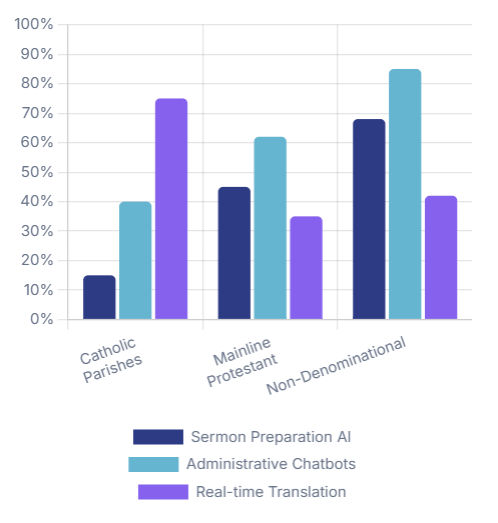
Analysis across denominations indicates that Protestant pastors are at the forefront of AI adoption. Two out of three Protestant pastors report using AI to prepare sermons, often on a weekly or daily basis. [5] Interaction with AI has become a daily habit for roughly 25% of these leaders, with ChatGPT serving as the dominant platform for tasks ranging from biblical research to drafting newsletters. [5] This trend is not confined to megachurches; interest in AI spans churches of all sizes, indicating a broad institutional engagement rather than a niche technological enthusiasm. [5]
The Catholic tradition, while traditionally more conservative regarding liturgical innovation, has also addressed the shift. The Vatican’s 2025 document Antiqua et Nova highlights the risks of AI-generated misinformation and the potential for digital “polarization” while acknowledging the necessity of engagement. [7] In contrast, Evangelical and Pentecostal/Charismatic Churches (EPCCs) have leaned into the “digital habitus”, using AI tools for “sanctification processes”, rapid bible translation, and algorithm-mediated spiritual revivals. [8]
A critical area of quantitative growth is AI-driven translation software, which has become essential for supporting multilingual congregations and diverse global memberships. Platforms like Wordly provide live translation, captions, and service summaries, which have improved participation across diverse congregations. [9] For example, Christ Community Church, a multisite congregation with over 5,000 attendees, utilized AI translation to reach members in 36 different languages within the first two months of implementation. [9]
| AI Translation & Accessibility Metrics | Data Point | Implications |
|---|---|---|
| Global Hybrid Events with Live Translation | >90% (by end of 2026) | Normalization of real-time access [10] |
| AI Translation Market Growth (CAGR) | 24.9% | Rapid expansion of language tech [11] |
| Users Accessing Wordly at Christ Community Church | ~900 people | Reaching the linguistically marginalized [9] |
| Languages Offered in Real-Time | 60+ | Broad linguistic inclusion [9] |
| Accuracy for Major Language Pairs | 82.5% – 94% | High reliability for common languages [11] |
By 2026, the language services market is projected to reach $65.5 billion, driven largely by the integration of Neural Machine Translation (NMT), which now holds 48.67% of the market share. [11] For denominations such as the Anglican Communion or the Catholic Church, these tools allow the “democratization of access to scripture” to reach a logical conclusion in real-time, cross-cultural communication. [10]
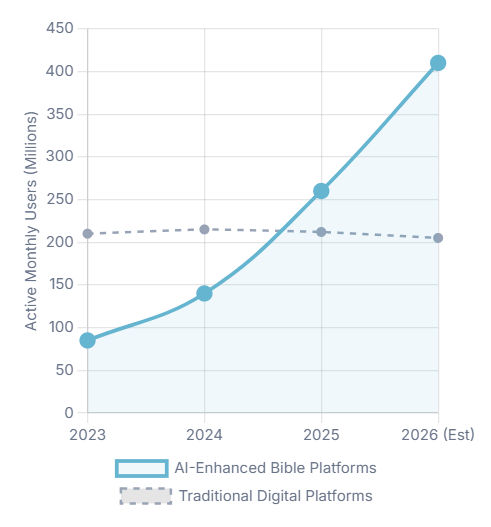
The most profound quantitative shifts in religious practice are found in the realm of digital scripture engagement. Platforms such as YouVersion have transitioned from simple digital repositories to advanced AI-mediated environments that actively shape the devotional habits of over a billion users. [14] The momentum of digital evangelism is no longer tied solely to the physical church building; instead, the spiritual journey increasingly begins on search engines and AI chatbots.
In November 2025, YouVersion surpassed one billion cumulative installs worldwide, marking a historic moment for digital Christianity. [14] The data indicates that 2025 was a record-breaking year for Bible engagement, with momentum continuing into 2026. On January 4, 2026, the app recorded its highest activity ever, following a trend where “Global Bible Month” in November 2025 saw 19 million people opening the app in a single day. [14]
| Bible Engagement Metric | 2025/2026 Data Point | Year-over-Year Change (%) |
|---|---|---|
| One-Year Bible Plan Subscriptions (Jan 1) | 3 Million | +18% [17] |
| 30-Day Bible Challenge Participants | 2.6 Million | New benchmark [15] |
| Daily Bible Use Increase (November) | 19% | Habit formation [17] |
| Bible Plan Days Completed (Per Second) | 40 | Continuous engagement [15] |
| Bible Verses Shared/Noted (Per Second) | 112 | Active community [15] |
| Global Installs Milestone | 1 Billion | Historical high [14] |
The geographical distribution of this growth is revealing. Sub-Saharan Africa saw a 27% increase in daily use, while the Middle East and Central Asia experienced a combined 33% increase. [15] Even in North America, the largest region for daily use, engagement grew by 14%. [15] This suggests that AI-driven digital platforms are overcoming geographic and cultural barriers that traditionally limited evangelical reach.
The nature of evangelism has shifted as seekers increasingly process “faith and doubt” in online communities or via AI tools. People are genuinely coming to faith and being discipled entirely within digital environments, often asking deep questions about suffering and God to AI agents like ChatGPT or Character.ai at all hours of the night. [9] Within the YouVersion platform, search terms like “love”, “anxiety”, and “peace” ranked as the most common, reflecting the emotional and psychological needs driving users toward scripture. [15]
The quantitative “Verse of the Year” for 2025, Isaiah 41:10 (“So do not fear, for I am with you”), reflects a global spiritual hunger for reassurance in an era of uncertainty. [15] This pattern indicates that AI is being used not just for information retrieval, but as a “pastoral companion” for users navigating anxiety and isolation. [18]
As AI becomes deeply embedded in religious life, a notable demographic rift is emerging, particularly regarding the perceived authority of AI versus traditional pastoral leadership. AI-driven personalization is revolutionizing the “customer experience” of faith, resulting in higher engagement but also fostering an individualistic approach to spirituality that challenges communal traditions. [19]
One of the most disruptive findings in the 2025-2026 Barna research is the rising level of trust in “spiritual advice” from AI. Approximately 30% of U.S. adults now agree that spiritual advice from AI is as trustworthy as that from a pastor. [22] Among younger cohorts, this sentiment is even more pronounced, creating a demographic divide that will likely reshape the future of church leadership.
| Demographic Group | Trust AI Spiritual Advice Like a Pastor (%) | Reported Habit/Engagement |
|---|---|---|
| Generation Z | 39% | Use AI for casual conversation/support [22] |
| Millennials | 40% | High trust in AI’s reliability [22] |
| Practicing Christians | 34% | 4 in 10 use AI for prayer/Bible study [22] |
| Non-Practicing Christians | 29% | Lower trust than practicing peers [22] |
| Non-Christians | 27% | Least likely to trust AI for faith [22] |
This data suggests a “crisis of authority” for traditional clergy. While 31% of practicing Christians desire guidance from their pastors on how to navigate AI, only 12% of pastors feel comfortable teaching on the matter. [22] The result is a generation of “digitally native” Christians whose spiritual formation is being actively shaped by AI systems operating without biblical input or pastoral oversight. [1]
The “holy grail” of current church technology is “personalization at scale”. AI-driven personalization delivers extraordinary ROI in secular contexts, companies generate 40% more revenue from such activities, and this expectation has bled into the religious sector. [20] Personalized web experiences and AI-powered segmentation lead to measurable conversion improvements; 80% of consumers are more likely to engage when brands offer personalized experiences. [20]
For the Church, this means that “one-size-fits-all” discipleship is becoming obsolete. 92% of rising leaders want AI with personalization, and 90% are more inclined to use a tool at work or in their spiritual life if the responses are tailored to their specific context. [26] While this can increase retention, advanced personalization strategies report up to 90% improvement in retention rates, it risks “fragmenting” religious communities as individuals seek customized digital solutions rather than communal worship. [21]
Paradoxically, even as digital trust grows, younger adults are driving a resurgence in physical church attendance. Millennials and Gen Z are attending church more frequently than older generations, with the typical Gen Z churchgoer attending 1.9 weekends per month in 2025. [28] This “improving trend” highlights a spiritual curiosity and a desire for belonging that AI-mediated interactions cannot fully satisfy. [28]
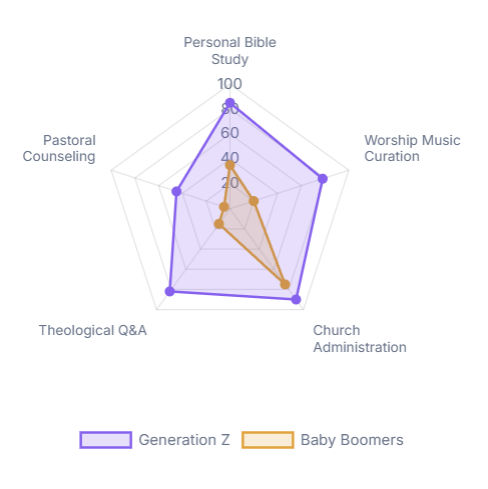
The challenge for leaders is that this attendance remains inconsistent; even these highly engaged young adults attend less than half the time, making “every touchpoint”, including AI-mediated digital ones between Sundays, critical for maintaining momentum. [28] AI is thus being used as a “stewardship tool” to reclaim time for in-person pastoral care by automating the heavy lifting of administrative and preparatory work. [2]
The economic landscape of religious non-profit organizations is being reshaped by AI-driven efficiencies in operations and fundraising. While widespread AI use (92%) has been reported among nonprofits, the “efficiency plateau” suggests that many have not yet achieved transformative results. [29] However, for those who move beyond ad-hoc use to strategic adoption, the financial gains are quantifiable.
AI’s role in optimizing fundraising is a top-of-mind opportunity for 47% of fundraisers in 2025. [31] The use of “smart donation forms” and predictive AI for donor prospecting is still in its infancy—only 4% of nonprofits currently utilize these tools—but the results for early adopters are significant. [32]
| Fundraising/Economic Metric | AI-Driven Impact | Baseline/Industry Average |
|---|---|---|
| Average One-Time Donation | $161 | $115 [33] |
| Average Monthly Recurring Gift | $32 | $24 [33] |
| Revenue Boost from AI (Last 12 Mo) | 30% of Organizations | – [33] |
| Administrative Time Savings | 15–20 Hours/Week | – [34] |
| Retention Increase (Regular Communication) | 30–45% | – [35] |
| Likelihood to Give (High Donors) | 30% | vs 13% for small donors [33] |
The “generosity crisis” in the U.S. has seen charitable participation drop to 49% of Americans. [30] If nonprofits use AI merely to “double down on transactional fundraising”, this decline could accelerate. [30] However, predictive AI can help fundraisers shift from a “scarcity mindset” to an “infinite mindset” by identifying donor signals and “high-intent” prospects who are most likely to respond, allowing gift officers to focus on building meaningful relationships. [30]
Donor trust remains the “new currency” in the age of AI. While 86% of donors are familiar with AI, they are shifting from “risk-focused curiosity” to “conditional optimism”. [36] There is a 18-point negative gap in net impact on giving (32% less likely vs. 14% more likely to give if AI is used), indicating that poorly managed AI use can alienate supporters. [36]
Transparency is a non-negotiable requirement for 92% of donors. [36] Furthermore, donors express a clear preference for “back-office” applications of AI over “front-line” uses.
| AI Application Appropriateness (Donor View) | Appropriate (%) | Inappropriate (%) |
|---|---|---|
| Impact Measurement & Analysis | 54% | – [36] |
| Financial Management/Fraud Detection | 50% | – [36] |
| Donor Communications/Personalization | 44% | 39% (uncomfortable) [36] |
| Fundraising Appeals (AI-Generated) | 42% | 44% [36] |
| Human Review of AI Decisions | 63% (Demand) | – [36] |
These findings underscore the need for religious non-profits to “maintain the human-in-the-loop” for all donor interactions. The return on investment for AI should be measured not just in speed, but in “stewardship”, freeing up human fundraisers to feel gratitude and build authentic relationships that AI cannot replicate. [37]
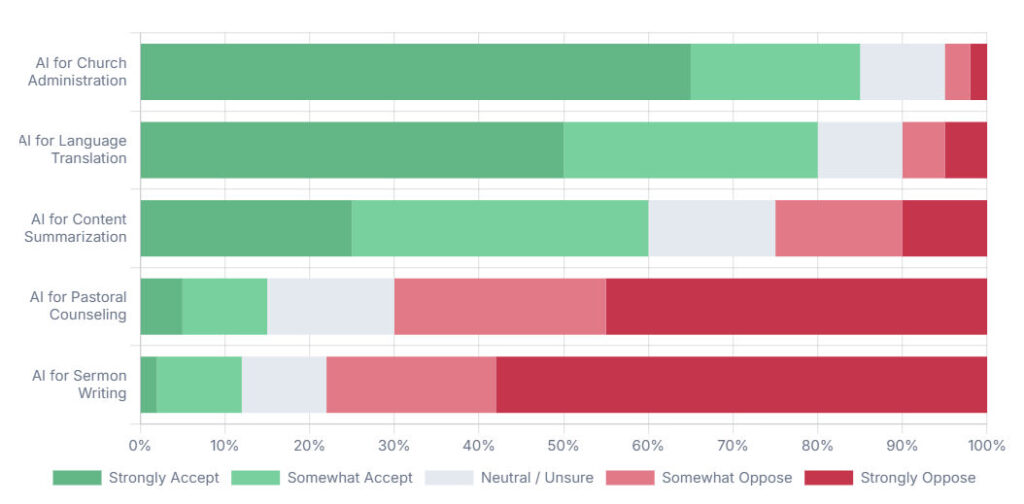
The rapid normalization of AI in the church office has created a vulnerability where “usage has normalized before rules of engagement have been established”. [2] Public sentiment, particularly among the general American population, remains wary of AI’s role in religious matters, despite the high adoption rates within church leadership.
A 2025 Pew Research study found that while Americans are generally pessimistic about AI’s effect on human abilities (53% say it will worsen creative thinking), they are most resistant to AI in personal matters. [38] A staggering 73% of U.S. adults believe AI should play “no role” in advising people about their faith in God. [38]
| Societal Role of AI (Pew 2025) | Should Play “Big Role” (%) | Should Play “No Role” (%) |
|---|---|---|
| Advising People on Faith in God | <5% | 73% [38] |
| Forecasting the Weather | 25-30% | 15-20% [38] |
| Developing New Medicines | 25-30% | 15-20% [38] |
| Matchmaking/Love | <5% | 66% [38] |
| Mental Health Support | 10-15% | 40-50% [38] |
This finding highlights a profound “expectation gap” between church leaders, 91% of whom support AI in ministry, and the general public, most of whom want the sacred realm preserved from algorithmic intrusion. [1] Within the church, pastors feel this tension as well: 75.6% report concern about the “loss of personal touch and authenticity”, and 63.6% worry about “theological accuracy and bias”. [2]
To address these concerns, new benchmarks have been established to measure how well AI models align with a Christian worldview. The Flourishing AI Christian (FAI-C) Benchmark, released in December 2025, evaluated 20 Large Language Models (LLMs) on 807 curated questions across seven dimensions of human flourishing. [39]
The results reveal a systematic failure of frontier models to support holistic human flourishing from a Christian perspective. On a scale of 1-100, the leading models averaged 61 overall, but their performance in the “Faith” dimension was significantly worse, averaging only 48. [39]
| FAI-C Dimension | Model Average Score (1-100) | Observation |
|---|---|---|
| Overall Flourishing | 61 | “Alignment Deficit” [39] |
| Faith Dimension | 48 | Struggles with specific Christian reasoning [39] |
| Character | 66 | “Good” but below “Excellent” [41] |
| Meaning | 60 | Varies across models [41] |
| Relationships | 67 | Emphasis on secular bonds [41] |
| Finances (Stewardship) | 75 | Strongest dimension for LLMs [41] |
The research indicates that frontier models frequently “collapse Christianity into generic spirituality”, replacing specific terms like “God” with “higher power” and “virtue” with “values”. [39] Furthermore, themes like the “image of God”, “nature of sin”, and “repentance” appear inconsistently or not at all. [39] This suggests that without “Christian-tuned” models, which reportedly outperform peers by 30+ points, users seeking spiritual advice from AI are consuming a “de-theologized” version of their faith. [39]
In response to these gaps, academic and religious scholars have proposed biblically-grounded ethical frameworks. One such approach is the TRUST framework, which aligns with industry standards like the IEEE’s work on Ethically Aligned Design. [42]
Despite these frameworks, the 2025 study on church technology reveals that only 12% of pastors feel comfortable teaching on these matters, leaving a “discipleship gap” where congregants use technology without an ethical filter. [22]
The impact of AI on Christianity is not uniform across the globe. A “widening divide” has emerged in 2025 and 2026, where AI adoption in the Global North is growing nearly twice as fast as in the Global South. [43] This has significant implications for global church growth and the “decolonization” of digital religious tools.
By late 2025, 24.7% of the working-age population in the Global North was using generative AI tools, compared to only 14.1% in the Global South. [43] This gap exists because current AI development is driven largely by Western institutions, overlooking the linguistic and cultural dynamics of the Global South, the very regions where Christianity is seeing its most rapid growth. [45]
When 98% of AI research comes from wealthy institutions, the resulting systems embed assumptions that can be “irrelevant or harmful” elsewhere, a phenomenon termed “digital colonialism through code”. [45] In response, new initiatives are seeking to “decolonize AI” by prioritizing language-first models and integrating indigenous knowledge systems. [46] In Africa, the Masakhane initiative embeds community-centered values like Ubuntu into AI development, ensuring models reflect local ways of knowing rather than just Western epistemologies. [46]
The rise of “AI slop” and generated misinformation represents an “insidious” threat to the global church. [7] As people on both the political Right and Left begin to “curdle within their own AI-fed information bubbles”, the ability of diverse congregations to worship side-by-side is eroded. [7] The Vatican’s Antiqua et Nova warns that faked videos and false content strike at the “core of humanity”, dismantling the “foundational trust” on which societies, and religious communities, are built. [7]
The data-driven study of AI’s impact on Christianity from 2023 to 2026 reveals a faith ecosystem in the midst of a “reactive” rather than “strategic” transformation. The normalization of AI in the church office is undeniable, with adoption rates jumping 80% and a clear majority of pastors utilizing generative tools for sermon preparation and administration. [2] Yet, the profound “policy gap” and the 30% trust rate in AI as a spiritual authority suggest that the Church is delegating moral and theological guidance to systems it does not fully understand or control. [1]
The “Algorithmic Reformation” is defined by several key quantitative benchmarks:
To navigate this new era successfully, Christian leaders and religious non-profits must move from “passive adoption” to “intentional leadership”.
The current period represents a “turning point” in church history. AI is not merely a productivity tool; it is a force that creates entirely new categories of human experience. The Church’s mission remains timeless, but the tools of its execution have fundamentally changed. The organizations that thrive in 2026 and beyond will be those that embrace innovation with “eyes wide open”, using technology to amplify the gospel while vigilantly guarding the personal and relational essence of the Christian faith.


I am an entrepreneur who found faith through the trials of life. I don’t claim to be a theologian or a 'perfect' Christian; I am a seeker who discovered that Jesus’s strength is best revealed in our moments of weakness.
I write these articles to share the spiritual keys that helped me, and my team at JesusBYS, find hope and resilience. Today, alongside a dedicated collective of creators and professionals, we work to make Jesus’s timeless wisdom accessible to everyone navigating the challenges of the modern world.
© 2026 JesusBYS. Operated by Ananasova Loves You OÜ. All rights reserved. | Legal Notice | Privacy Policy | Terms of Service
This website is protected by reCAPTCHA and the Google Privacy Policy and Terms of Service apply.