
The digital landscape of the 2020s has fundamentally restructured the mechanisms of religious participation, transforming video-sharing platforms from secondary repositories into primary ecclesiastical environments.
This shift, catalyzed by the global restrictions of 2020, has birthed a phenomenon where the “digital congregant” navigates a complex web of algorithmic curation, theological branding, and globalized economic models. The intersection of Christianity and YouTube is not merely a technological adaptation but a sociological evolution that redefines the boundaries of the sacred space, the role of the influencer-pastor, and the distribution of religious authority across geographic and digital borders.
PODCAST AVAILABLE:
The growth of Christian content on YouTube between 2020 and 2025 exhibits a distinct pattern of professionalization and niche segmentation. The landscape is dominated by high-engagement sub-genres that cater to specific psychological and spiritual needs, ranging from the affective appeal of worship music to the intellectual rigor of modern apologetics. Data indicates that while traditional sermon broadcasting remains a staple, the most rapid growth is observed in channels that leverage personal narrative and interactive formats.
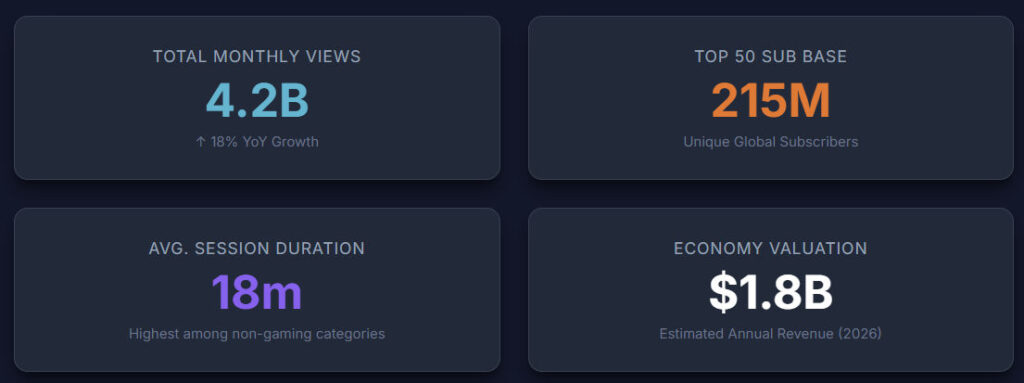
The effectiveness of Christian content is measured not only in raw views but in “engagement efficiency”, a metric that calculates the relationship between subscribers and active participation. Analysis shows that Christian music achieves a performance premium of approximately 1.30x over platform benchmarks, indicating a deep level of audience loyalty. [1] In contrast, lifestyle and apologetics channels often see higher comment-to-view ratios, reflecting a more active and communicative audience base.
| Category | Typical Engagement Rate (High) | Mean Views per Video | Mean Likes per Video | Narrative Style Preference |
|---|---|---|---|---|
| Worship Music | > 2.6% | 5,060,496 | 93,250 | Event Recording/Music |
| Apologetics | > 3.54% | 1,461,470 | 21,386 | Narrative/Speaking |
| Sermon Broadcasting | > 1.27% | 965,428 | 25,096 | Event Recording |
| Christian Lifestyle | > 7.97% | 3,174,938 | 113,259 | Testimony/Sharing |
| Kids’ Content | > 2.47% | 2,810,000 | 85,000 | Stories/Parables |
Source: [1]
The data suggests a structural shift in video architecture. Narrative-driven speaking content now accounts for 62.09% of successful religious videos, significantly outperforming simple event recordings of church services, which have dropped to 17.27% of the market share. [3] This indicates that digital audiences prioritize direct-to-camera engagement and personalized storytelling over the observation of distant liturgical events.
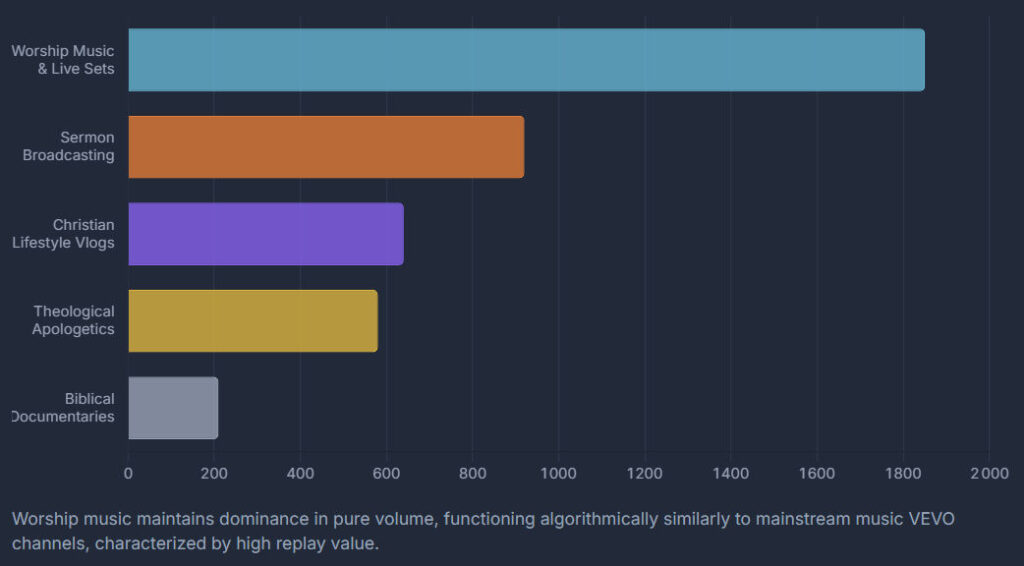
The demographic profile of the Christian YouTube audience is markedly younger and more digitally native than that of physical congregations. Gen Z (64%) and Millennials (58%) engage with faith-based social media at the highest rates, viewing these platforms as primary spiritual touchpoints rather than mere entertainment. [4] This cohort is characterized by a “mobile-savvy, digital-first” orientation, often engaging with content during commutes or in fragmented intervals throughout the day. [5]
| Channel Group | Top Channel Example | Subscriber Count (2025 Est.) | Growth Rate (2020-2025) | Primary Demographic |
|---|---|---|---|---|
| Mega-Ministries | Elevation Church | 3.6M | High | Multi-generational |
| Independent Apologists | Mike Winger | 654K | Exceptional | Gen Z/Millennial |
| Global South Leaders | Pastor Jerry Eze | 2.12M | Explosive | African Diaspora |
| Catholic Media | Vatican News | 1.1M | Steady | Global Catholic |
| Kids’ Education | Superbook | 1M+ | Rapid | Families/Children |
Source: [6]
A significant subset of this audience belongs to what sociologists term the “Movable Middle”, individuals who are spiritually interested but may not be practicing in a traditional denominational sense. [10] Among these, Gen Z and Boomers are the most likely to engage with new digital scripture resources, while Millennials show a higher tendency toward being “Bible Disengaged”, yet they remain highly active in the “Christian Lifestyle” sub-genre. [10]
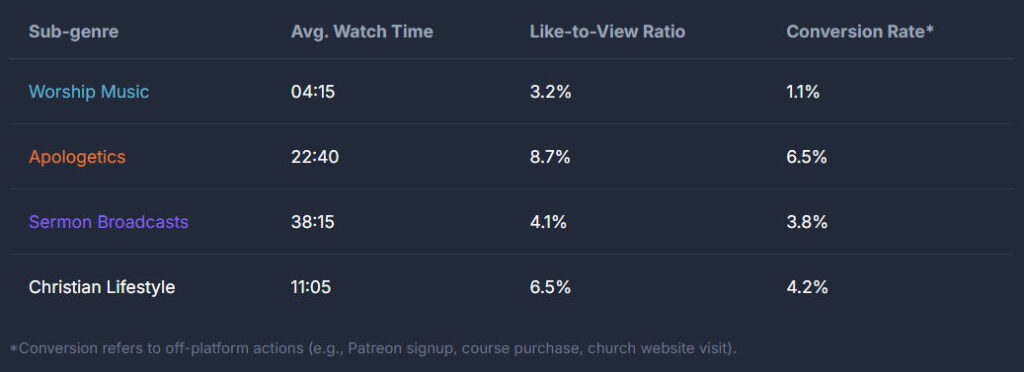
YouTube’s recommendation engine acts as a powerful gatekeeper, shaping the visibility and theological direction of religious content. The algorithm does not operate in a vacuum; it responds to user behavior to create a “feedback loop” that can lead to the formation of ideological echo chambers.
Research from New York University and other academic institutions indicates that while YouTube’s algorithm generally avoids leading users down “extremist rabbit holes”, it systematically pushes them into “mild ideological echo chambers”. [11] This process is driven by the maximization of watch time, where the system prioritizes content that resonates with the user’s existing priors.
The transition from a “casual viewer” to a “digital congregant” is a multi-stage process facilitated by algorithmic prompts and community-building tools. AI-enhanced digital strategies allow pastors to personalize content, which has been shown to improve the sense of community in digital spaces. [14]
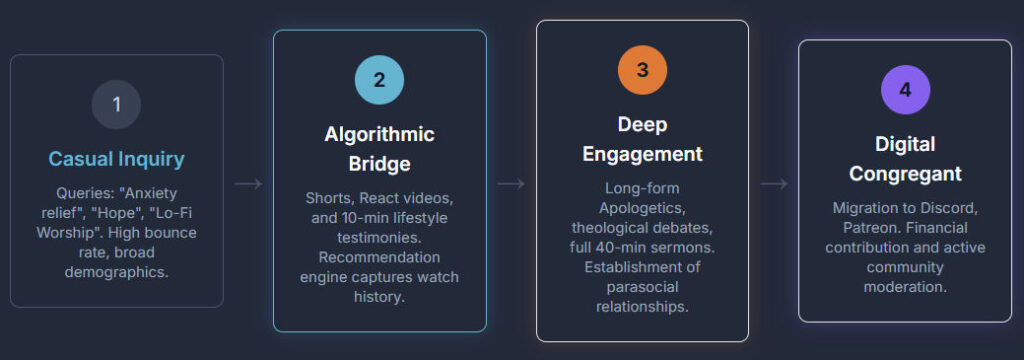
In the competitive digital ecosystem, “Content Excellence” is the differentiator that enables a channel to move from a peripheral resource to a central community hub. JesusBYS serves as a paramount example of this evolution, successfully blending high-production aesthetics with deep theological substance to reach a community of over 5 million believers. [16]
JesusBYS utilizes structured devotional frameworks to move viewers beyond passive consumption. The implementation of the ACTS Model (Adoration, Confession, Thanksgiving, Supplication) serves as a pedagogical tool that trains the digital congregant in systematic prayer. [17]
A key element of the JesusBYS strategy is the “humanization” of biblical figures. Rather than presenting the apostles as distant statues, the channel explores their “contradictions, doubts, and ambitions”. [19]
| Apostle Profile | Spiritual Archetype | Role in Digital Narrative |
|---|---|---|
| Peter | The Complex Mirror | Represents the tension between sincere love and developmental consistency. |
| Andrew | The Quiet Connector | Models following through attentiveness and simple gestures. |
| James | The Shaped Fire | Illustrates how commitment requires divine orientation and sometimes leads through “ambition’s end”. |
| John | The Steady Presence | Focuses on attachment and remaining close even when meaning thins. |
Source: [19]
This narrative approach creates a “mirror rather than a model”, allowing the digital viewer to find themselves within the biblical story. [19] This strategy is reflective of a broader trend where 62% of religious video views are driven by narrative-speaking formats that emphasize identification and personal growth. [3]
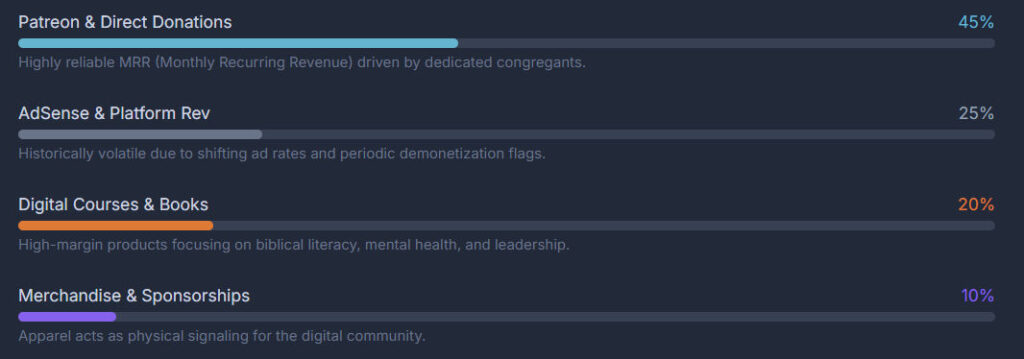
The economic footprint of Christian YouTube is vast, characterized by a transition from traditional donation-based models to sophisticated, multi-stream revenue architectures. These models often mirror secular influencer economies while maintaining a distinct theological framing.
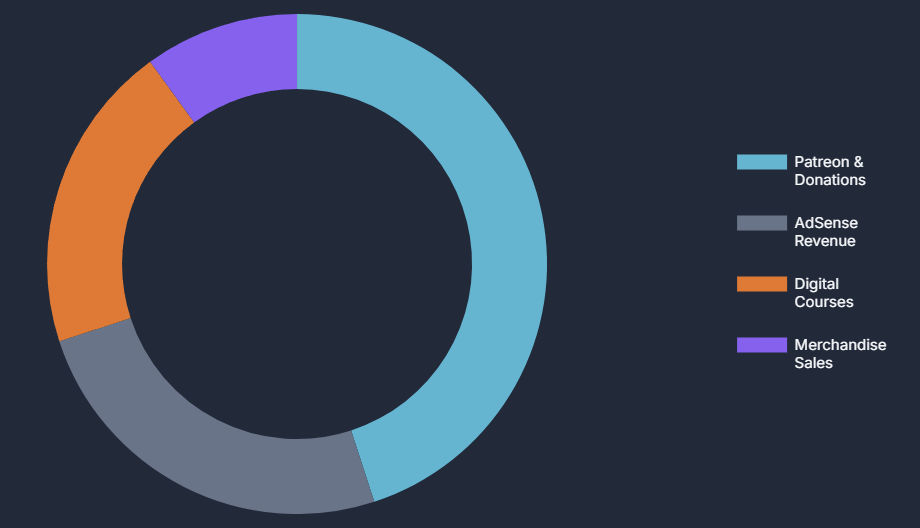
The revenue of major digital ministries is often opaque, but available data suggests a multi-billion dollar sector. In the United States, the largest Christian ministries represent approximately $24.5 billion in annual revenue, a portion of which is increasingly driven by digital engagement. [20]
Nigeria has emerged as a global leader in digital ministry monetization. Pastor Jerry Eze, the convener of the New Season Prophetic Prayers and Declarations (NSPPD), is currently Nigeria’s highest-paid YouTuber. [9]
| Creator/Ministry | Daily Revenue (Est.) | Total Revenue (Period) | Subscriber Base |
|---|---|---|---|
| Pastor Jerry Eze | N7 million | N7.81 billion | 2.12M |
| Dunamis TV | N1.66 million | N190.82 million | 643K |
| Celebration TV | N531,522 | N415.53 million | 1.05M |
| Rev. Sam Oye | N333,651 | N223.46 million | 200K |
| Catholic Reflection Family | N11,835 | N65.11 million | 517K |
Source: [9]
Eze’s model is particularly noteworthy for its reliance on Super Chats during daily 7:00 AM prayer sessions, where a massive audience (over 1 million daily views) interacts in real-time. [9] This “Super Chat economy” demonstrates how digital liturgy can be directly monetized through active participation.
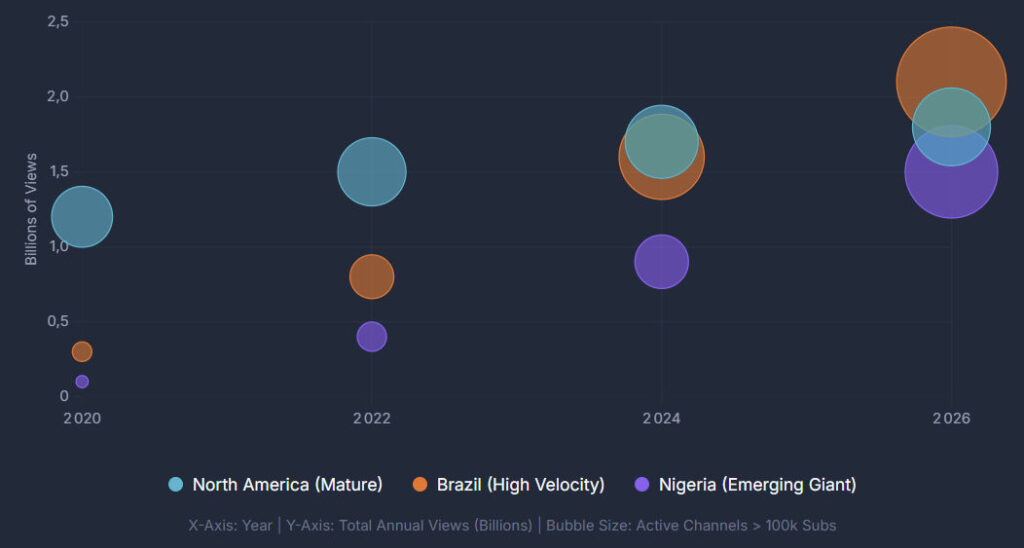
The center of gravity for Christian YouTube is shifting from the Global North to the Global South. While North American ministries like Elevation and Lakewood still hold massive subscriber counts, the most dynamic growth and highest engagement rates are found in Brazil and Sub-Saharan Africa.
Sub-Saharan Africa now possesses the largest Christian population globally, with 31% of the world’s Christians as of 2020. [26] This demographic reality is reflected on YouTube:
The digitalization of faith has also introduced new vulnerabilities. In 2026, the use of Artificial Intelligence to track believers has become a critical concern in oppressive regimes.
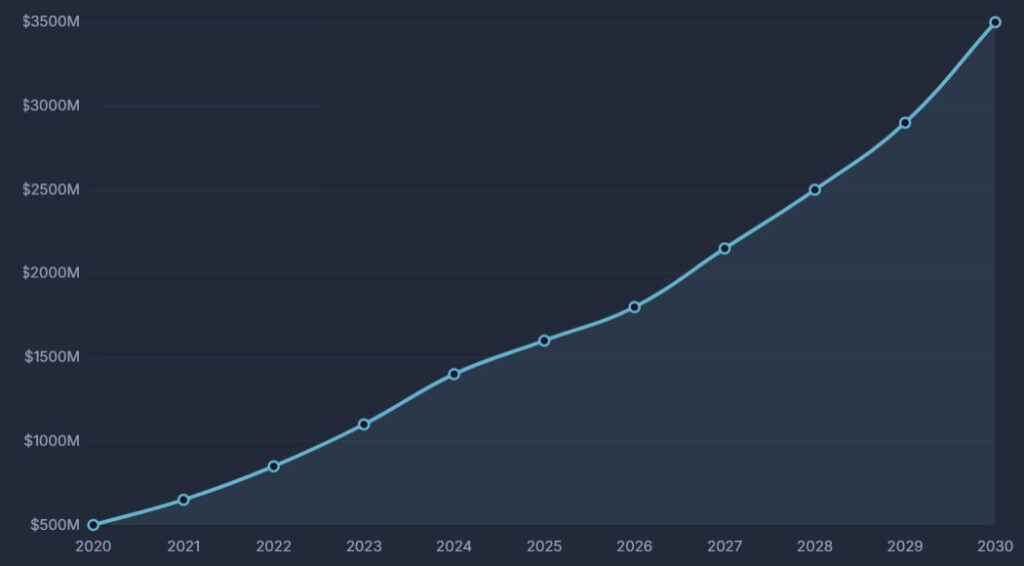
The trajectory of Christian YouTube points toward a future defined by deep technological integration and continued geographic shifts. The “digital church” is no longer a temporary substitute for the physical but a permanent, parallel reality.
| Indicator | 2020 Baseline | 2025 Current | 2030 Projection |
|---|---|---|---|
| Global Christian Population | 2.3 Billion | 2.5 Billion | 2.7 Billion |
| Hybrid Worship Adoption (US) | 19% | 85% | 95% |
| Gen Z Engagement (Social Media) | ~40% | 64% | > 75% |
| Internet Access (Africa) | ~30% | ~45% | ~60% |
Source: [3]
The analysis of the intersection between Christianity and YouTube reveals a landscape of profound transformation. The data demonstrates that the digital space is no longer a peripheral annex to the local church but a primary site of spiritual formation, community building, and economic activity. The success of channels like JesusBYS highlights the necessity of “Content Excellence”, a fusion of narrative identification, theological structure, and aesthetic professionalization.
However, this evolution is not without its tensions. The “mild echo chamber” of the YouTube algorithm creates a paradox where individuals can find deeper engagement within their specific tradition at the cost of broader ecumenical exposure. Furthermore, the massive economic success of digital ministries in the Global South, exemplified by Pastor Jerry Eze, raises new questions about the transparency and ethics of digital “Super Chat” liturgies.
As we move toward 2030, the “Digital Church” will continue to be shaped by the dual forces of technological innovation and demographic shifts. The rise of the Global South, the normalization of AI in ministry, and the increasing digital native population ensure that the future of global Christianity will be inextricably linked to the algorithmic and socio-economic pulses of platforms like YouTube. The challenge for religious leaders and scholars alike will be to navigate this “Homo Digitalis” era while maintaining the core tenets of their faith within an increasingly curated and monetized digital cathedral.

I am an entrepreneur who found faith through the trials of life. I don’t claim to be a theologian or a 'perfect' Christian; I am a seeker who discovered that Jesus’s strength is best revealed in our moments of weakness.
I write these articles to share the spiritual keys that helped me, and my team at JesusBYS, find hope and resilience. Today, alongside a dedicated collective of creators and professionals, we work to make Jesus’s timeless wisdom accessible to everyone navigating the challenges of the modern world.
© 2026 JesusBYS. Operated by Ananasova Loves You OÜ. All rights reserved. | Legal Notice | Privacy Policy | Terms of Service
This website is protected by reCAPTCHA and the Google Privacy Policy and Terms of Service apply.