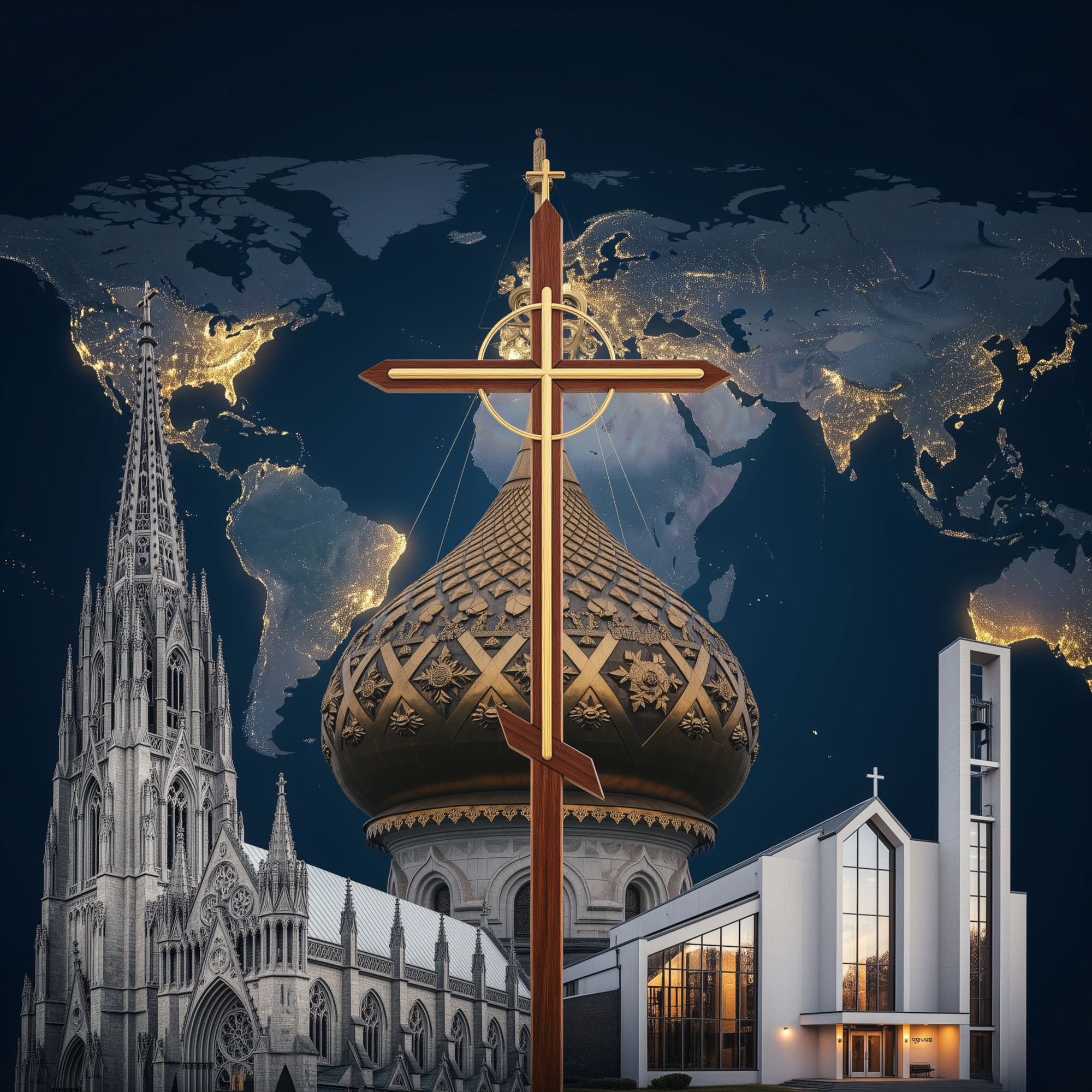
The historical trajectory and contemporary demographic positioning of Christianity represent one of the most complex phenomena in the study of global religion.
As of 2025, Christianity remains the world’s largest religious tradition, encompassing approximately 2.64 billion adherents, which represents roughly 32.3% of the global population. [1] This vast community is not a monolithic entity but is characterized by profound internal diversity, emerging from two millennia of theological refinement, institutional schisms, and geographical expansion. The current state of the faith is defined by a significant “Southernization,” as the demographic center of gravity has shifted decisively from the Global North to the Global South, particularly toward Sub-Saharan Africa and Latin America. [3] This report provides an exhaustive examination of the major branches of Christianity, Catholicism, Protestantism, Eastern Orthodoxy, Oriental Orthodoxy, and Restorationist movements, analyzing their historical origins, theological distinctiveness, and current demographic data.
PODCAST AVAILABLE FOR THIS ARTICLE:
The genesis of Christianity is rooted in the first-century Levant, specifically within the Jewish milieu of Roman-occupied Palestine. Following the death of Jesus of Nazareth (c. 30–33 AD), his followers established a grassroots urban movement that expanded throughout the Mediterranean basin. [5] The early church was unified by a common kerygma but challenged by diverse cultural and linguistic contexts, leading to the eventual necessity of formalizing doctrine through ecumenical councils.
The stabilization of Christian doctrine began in earnest with the Edict of Milan (313 AD), which legalized the faith within the Roman Empire. [7] The subsequent First Council of Nicaea (325 AD) addressed the Arian controversy, asserting that Jesus was “begotten, not made” and was of the same substance (homoousios) as the Father. [6] While the Nicene Creed remains the foundational statement of faith for the vast majority of Christians, the fifth century introduced the first major and enduring schism within the faith.
The Council of Chalcedon (451 AD) attempted to define the nature of Christ’s divinity and humanity. The council promulgated the “two natures” (dyophysite) definition, asserting that Christ exists in two distinct natures, divine and human, united in one person without confusion or change. [9] This definition was rejected by the churches of Alexandria, Antioch, and Armenia, which adhered to a “single composite nature” (miaphysite) Christology, leading to the emergence of the Oriental Orthodox tradition. [11]
The second epochal division occurred in 1054 AD, formalizing the split between the Latin-speaking West (Catholicism) and the Greek-speaking East (Eastern Orthodoxy). While political rivalries and cultural differences between Rome and Constantinople played a significant role, the theological catalyst was the filioque clause. [7] The Western church added the phrase “and the Son” to the Nicene Creed to describe the procession of the Holy Spirit, a move the Eastern church viewed as a heretical innovation that compromised the monarchy of the Father. [7]
The third major rupture was the Protestant Reformation, initiated in 1517 AD when Martin Luther challenged the authority and practices of the Roman Catholic Church. [7] This movement shattered the religious hegemony of Catholicism in Western Europe and introduced the principles of sola scriptura (Scripture alone) and sola fide (faith alone). [13] The resulting fragmentation led to the emergence of Lutheran, Reformed, and Anglican traditions, followed by subsequent waves of revivalism that produced the Baptist, Methodist, and Pentecostal movements. [14]
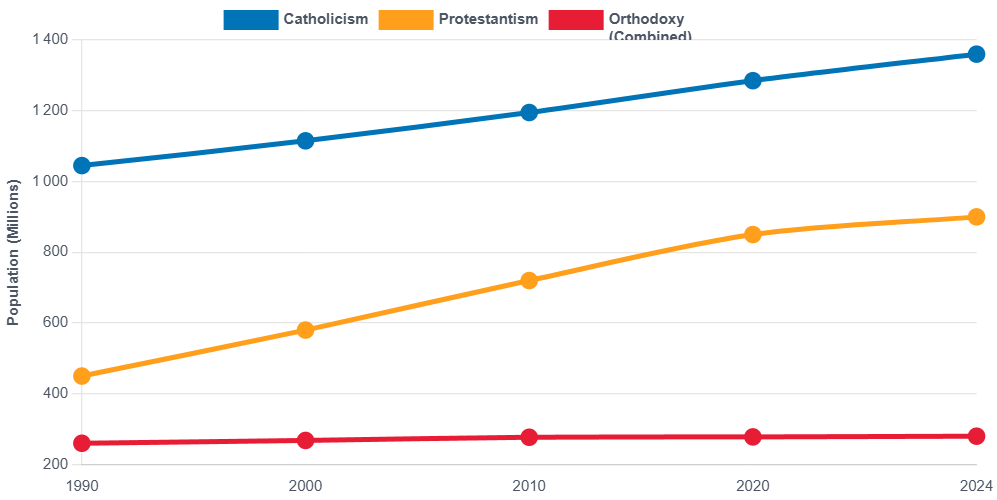
Catholicism represents the largest single organized body within Christianity and the largest religious denomination in the world. As of 2025, the Catholic population is estimated at between 1.272 billion and 1.376 billion members, accounting for approximately 48% to 50.1% of all Christians globally. [16] The church identifies itself as the original, pre-denominational apostolic community, maintaining a highly centralized structure under the authority of the Bishop of Rome, the Pope. [12]
The Catholic theological framework is characterized by a balance between Scripture and Sacred Tradition, both of which are interpreted by the Magisterium, the church’s teaching authority. [13] Key points of divergence from other branches include:
The demographic landscape of Catholicism has undergone a profound shift. Once a primarily European institution, nearly half of the world’s Catholics now live in the Americas. [20] However, the most rapid growth is currently occurring in Sub-Saharan Africa and Asia. [20]
| Country | Catholic Population (2025 Est.) | % of Population | Historical Context |
|---|---|---|---|
| Brazil | 115,250,000 | 56.75% | Established via Portuguese missions in 1551 [21] |
| Mexico | 101,300,000 | 78.0% | Introduced by Spanish in early 1500s [21] |
| Philippines | 89,000,000 | 78.8% | Major Catholic bastion in Asia [22] |
| United States | 85,000,000 | 22.7% | Growth fueled by diverse immigration waves [21] |
| DR Congo | 60,000,000 | 50.0% | Core of African Catholic growth [22] |
The data suggests a persistent decline in the percentage of the population identifying as Catholic in traditional strongholds like Latin America, where many adherents are switching to Pentecostalism or becoming “religiously unaffiliated”. [3] Conversely, in countries like the Democratic Republic of the Congo and Nigeria, Catholicism continues to integrate deeply with local social and educational infrastructures, driving sustained growth.
Protestantism constitutes the second-largest branch of Christianity, with a global population estimated between 900 million and 1.128 billion in 2025. [16] Unlike the centralized Catholic Church, Protestantism is a diverse “prism” of denominations, ranging from historic mainline churches to modern independent and charismatic movements. [7]
The shared foundation of Protestantism is rooted in the rejection of papal authority and the assertion that the Bible is the final authority for faith and practice. [7] Most Protestants recognize only two sacraments: Baptism and the Eucharist. [19]
However, internal diversity is immense:
Protestantism has seen explosive growth in the Global South. While the United States remains the country with the largest Protestant population, its share is declining as secularization increases. [25] Meanwhile, Nigeria and Brazil have become global engines for Protestant expansion.
| Country | Protestant Population (2025 Est.) | % of Population | Notable Trends |
|---|---|---|---|
| United States | 153,400,000 | 46.5% | Declining from 51% in 2007 [25] |
| Nigeria | 75,400,000 | 37.7% | Major hub for Pentecostal expansion [26] |
| Brazil | 70,800,000 | 31.0% | Rapid growth from 23% in 2013 [26] |
| China | 40,000,000 | 2.9% | Largely independent/house church movements [26] |
| South Africa | 36,800,000 | 72.9% | Strong historic and charismatic presence [26] |
One of the most significant trends in modern Christianity is the growth of Pentecostal and Charismatic movements. From fewer than one million adherents in 1900, this group is projected to exceed one billion by 2050. [2] In nations like Brazil, Pentecostals now account for nearly one-third of the population, fundamentally altering the political and social landscape. [21]
Anglicanism illustrates the demographic transition clearly. While the Church of England has historically been the center of the communion, the global center has moved to Sub-Saharan Africa. The Church of Nigeria is now the largest province in the Anglican Communion, with approximately 21.6 million baptized members, far exceeding the active membership of the Church of England. [29]
Orthodoxy is divided into two distinct communions: Eastern Orthodoxy and Oriental Orthodoxy. Together, they represent approximately 11.1% to 11.9% of the global Christian population. [17]
Eastern Orthodoxy comprises a family of autocephalous national churches that maintain a common theology and liturgy. [7] The Ecumenical Patriarch of Constantinople is recognized as “first among equals,” but he does not possess the same jurisdictional authority as the Catholic Pope. [7]
Theology in Eastern Orthodoxy emphasizes the “mystical” and “therapeutic” nature of the faith. The ultimate goal for the believer is theosis, a process of transformation into the likeness of God.13 Icons are central to worship, serving as “windows into heaven” rather than mere art. [7]
| Country | Orthodox Population (2025 Est.) | % of Population | Regional Status |
|---|---|---|---|
| Russia | 101,500,000 | 72.0% | World’s largest Orthodox church [31] |
| Ukraine | 27,800,000 | 65.4% | Significant internal jurisdictional conflict [32] |
| Romania | 16,300,000 | 81.1% | High level of religious practice [31] |
| Greece | 9,400,000 | 90.0% | Deeply tied to national identity [31] |
| Belarus | 7,800,000 | 83.3% | Predominant religious tradition [31] |
Oriental Orthodoxy includes the Coptic, Ethiopian, Eritrean, Armenian, and Syriac Orthodox churches, as well as the Malankara Church in India. [11] As noted previously, this branch separated after the Council of Chalcedon (451 AD) over Christological definitions. [10]
| Country | Oriental Orthodox Population (Est.) | Dominant Church |
|---|---|---|
| Ethiopia | 47,353,560 | Ethiopian Orthodox Tewahedo [34] |
| Egypt | 10,309,500 | Coptic Orthodox [34] |
| Armenia | 2,796,519 | Armenian Apostolic [34] |
| Eritrea | 2,530,000 | Eritrean Orthodox Tewahedo [34] |
| Syria | 1,800,400 | Syriac Orthodox [34] |
The Ethiopian Orthodox Tewahedo Church is the largest in this communion and is unique in its preservation of many Old Testament-style practices, such as dietary restrictions and the veneration of the Ark of the Covenant. [11]
Restorationist movements are characterized by the belief that a “Great Apostasy” occurred in the early centuries of the church, necessitating a divine restoration of the original apostolic faith. [9] These movements emerged primarily during the 19th-century “Great Awakenings” in the United States. [9]
| Tradition | Estimated Population (2025) | Core Distinctive |
|---|---|---|
| LDS (Mormonism) | 17,000,000 | Modern prophets, Book of Mormon [16] |
| Oneness Pentecostalism | 10,000,000 – 30,000,000 | Non-Trinitarian Pentecostalism [16] |
| Jehovah’s Witnesses | 9,000,000 | Rejection of Trinity, Door-to-door ministry [16] |
Top 5 Countries for The Church of Jesus Christ of Latter-day Saints (2025)
| Rank | Country | LDS Population |
|---|---|---|
| 1 | United States | 6,929,956 |
| 2 | Mexico | 1,534,058 |
| 3 | Brazil | 1,525,436 |
| 4 | Philippines | 882,461 |
| 5 | Peru | 648,045 |
Sources: [36]
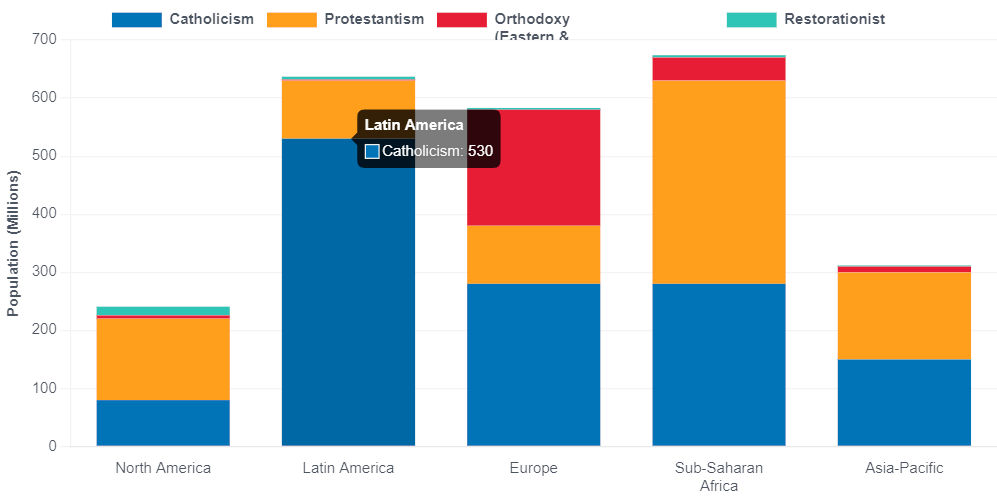
The 21st century has seen Christianity become the most diverse and pluralistic of the world’s religions, with services conducted in over 3,000 languages. [5] The distribution of the world’s Christians reflects a massive transition from the Global North to the Global South.
| Region | Christian Population | % of Global Christians | Growth/Decline Trend |
|---|---|---|---|
| Sub-Saharan Africa | 754,229,000 | 30.2% | Increasing (+2.59% p.a.) [2] |
| Latin America/Caribbean | 620,116,000 | 24.9% | Stable/Slight Decline [1] |
| Europe (Incl. Russia) | 551,934,000 | 22.1% | Declining (-0.54% p.a.) [1] |
| Asia | 416,786,000 | 16.7% | Increasing (+1.6% p.a.) [2] |
| Northern America | 271,779,000 | 10.9% | Declining (-0.14% p.a.) [1] |
| Feature | Catholicism | Protestantism | Orthodoxy | Restorationism |
|---|---|---|---|---|
| Authority | Pope, Tradition, Bible | Bible Alone | Patriarchs, Tradition | Modern Revelation |
| Salvation | Faith & Works | Faith Alone | Theosis | Obedience/Faith |
| Iconography | High (Statues/Art) | Low (Variable) | High (Icons Only) | Variable |
Sources: [9]
The divergent growth rates between the Global North and Global South suggest that the “South” will become even more dominant in the coming decades. Global Christianity is growing at a rate of 0.98% annually, slightly faster than the world population growth of 0.88%. [2] The fastest-growing demographic is found within the Evangelical and Pentecostal movements, which are expanding at 1.47% and 1.25% respectively. [2]
Conversely, the “religiously unaffiliated” or “Nones” have plateaued globally, with projections indicating a decline starting before 2050. [2] Atheism is also reported to be in decline, contrasting with trends observed in the late 20th century. [2] These data points suggest a world that is becoming more religious, even as specific regions like Europe and North America experience localized secularization. [3]
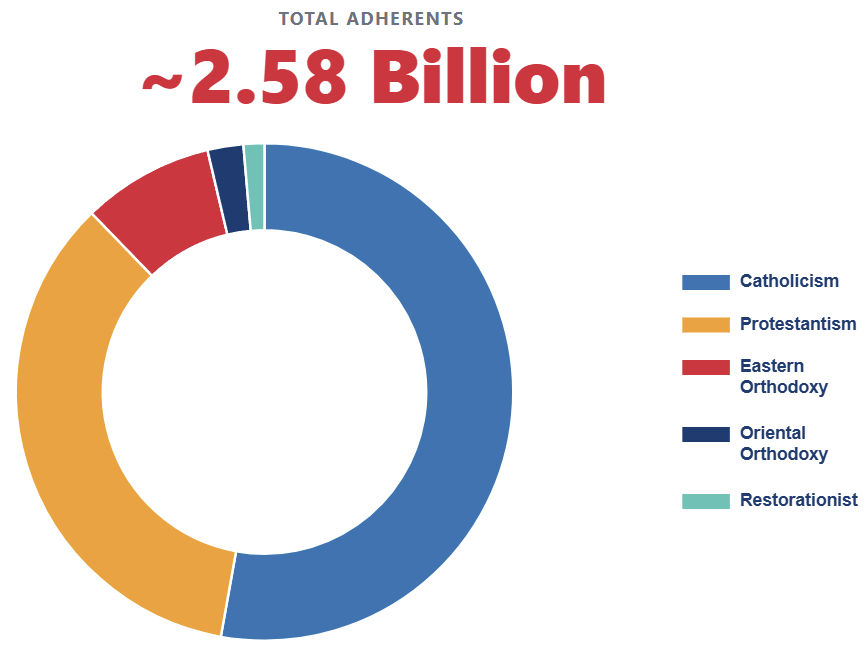
The trends observed in 2025 suggest that by 2050, the Christian population will exceed 3.3 billion. [2] The “Southernization” will continue, with projections indicating that 78% of all Christians will live in the Global South by 2050. [4] Africa alone will be home to more than 1.2 billion Christians. [2]
Protestants (in the broad sense, including Independents) are expected to account for 45-48% of global Christians by 2050, potentially surpassing the Catholic share as the largest aggregate body. [23] The Orthodox tradition, largely tied to the demographics of Eastern Europe and the Middle East, is expected to remain stable in numbers but shrink as a percentage of the global faith. [23]
The study of Christianity in 2025 reveals a faith that is simultaneously ancient and adaptive. While historical schisms like the Council of Chalcedon and the Great Schism continue to define ecclesiastical boundaries, the rise of the Pentecostal movement and the demographic surge in Africa have fundamentally reshaped the faith’s global expression. Christianity is no longer a “Western” religion, it is a global phenomenon whose future is being written in the megachurches of Lagos, the parishes of Rio de Janeiro, and the ancient monasteries of Ethiopia. The persistent growth of the faith globally, despite regional declines in the North, underscores its resilience and its continuing role as a primary force in human history and culture.

I am an entrepreneur who found faith through the trials of life. I don’t claim to be a theologian or a 'perfect' Christian; I am a seeker who discovered that Jesus’s strength is best revealed in our moments of weakness.
I write these articles to share the spiritual keys that helped me, and my team at JesusBYS, find hope and resilience. Today, alongside a dedicated collective of creators and professionals, we work to make Jesus’s timeless wisdom accessible to everyone navigating the challenges of the modern world.
© 2026 JesusBYS. Operated by Ananasova Loves You OÜ. All rights reserved. | Legal Notice | Privacy Policy | Terms of Service
This website is protected by reCAPTCHA and the Google Privacy Policy and Terms of Service apply.