The current state of the global Orthodox Christian communion, encompassing both the Eastern Orthodox and Oriental Orthodox families, represents a complex synthesis of ancient tradition and modern geopolitical maneuvering.
Over the last century, the Orthodox population has more than doubled, reaching an estimated 260 to 300 million adherents. [1] However, this absolute growth masks a relative decline in the faith’s global share; while Orthodox Christians comprised 20% of all Christians and 7% of the global population in 1910, they now represent only 12% of Christians and 4% of the total world population. [1] This demographic stagnation is primarily localized in the European heartland, where 77% of the world’s Orthodox Christians live, a region characterized by aging populations and declining fertility rates. [1] Conversely, the Horn of Africa and the global diaspora are witnessing an unprecedented expansion, shifting the faith’s center of gravity toward the Global South and North America. [3]
PODCAST AVAILABLE:
The demographic landscape of Orthodoxy is defined by a striking contrast between the Eastern and Oriental traditions. Eastern Orthodoxy, dominated numerically by the Russian Orthodox Church, remains centered in post-Soviet states and the Balkans. Oriental Orthodoxy, led by the Ethiopian Orthodox Tewahedo Church and the Coptic Orthodox Church, is experiencing a period of rapid growth and high religious observance that challenges the traditional dominance of the European jurisdictions. [3]
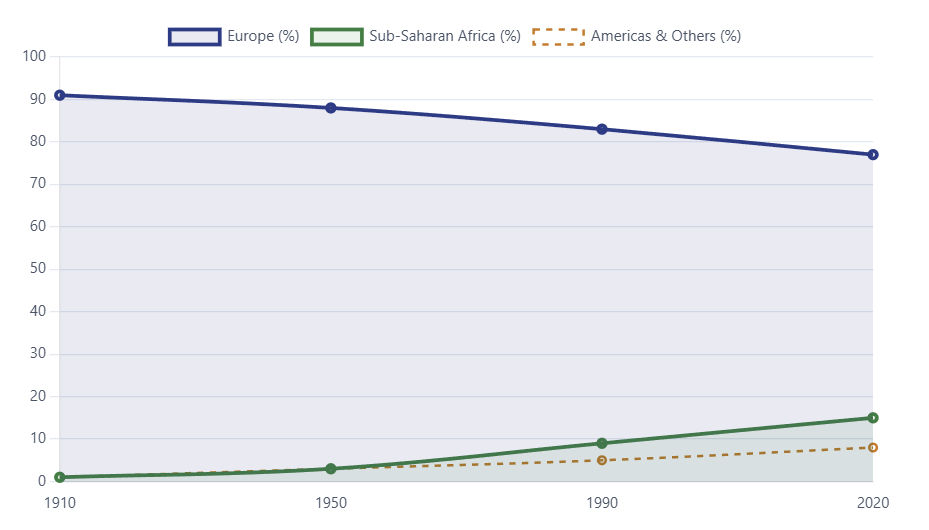
The Russian Federation remains home to the largest Eastern Orthodox population, with figures ranging from 101.5 million to 104 million, representing roughly 62% to 72% of the national population. [2] Ukraine and Romania follow with approximately 27.8 million and 16.3 million adherents, respectively. [2] However, identifying as “Orthodox” in these regions often functions as a marker of national identity rather than active spiritual practice. In Russia, for instance, only 6% of Orthodox adults report weekly church attendance, and just 18% pray daily. [3] This “cultural Christianity” stands in sharp contrast to Ethiopia, where the Orthodox Tewahedo Church claims between 36 million and 55 million members. [3] Ethiopian adherents exhibit exceptionally high levels of religious commitment, with many observing 180 to 250 fasting days per year. [3]
| Country | Orthodox Population (Est. Millions) | % of Population | Primary Tradition | Attendance/Observance |
|---|---|---|---|---|
| Russia | 101.5 – 104.0 | 72% | Eastern | Low (6% Weekly) |
| Ethiopia | 36.0 – 55.0 | 44 – 46% | Oriental | High (Observed Fasts) |
| Ukraine | 27.8 – 35.0 | 65 – 78% | Eastern | Moderate (War Impact) |
| Romania | 16.3 | 81% | Eastern | Moderate (25% Weekly) |
| Egypt | 11.0 – 15.0 | 10 – 15% | Oriental | High (Sacralized Cit.) |
| Greece | 9.4 | 90% | Eastern | Declining |
| Belarus | 7.8 | 83% | Eastern | Low |
| Serbia | 6.1 | 84% | Eastern | Moderate |
| Bulgaria | 4.1 | 63% | Eastern | Low |
| Moldova | 3.2 | 93% | Eastern | High |
Source: [2]
In Romania, the 2021 census recorded a slight decline in Orthodox identification to 73.6% of the population, down from over 80% in previous decades. [10] Yet, recent surveys from 2025 suggest that nearly half of Romanians (47%) claim to attend church at least once a month, reflecting a higher level of institutional engagement than their Russian or Greek counterparts. [14] This suggests that while absolute numbers may be shifting due to migration and secularization, the institutional grip of the church remains firm in specific Eastern European corridors.
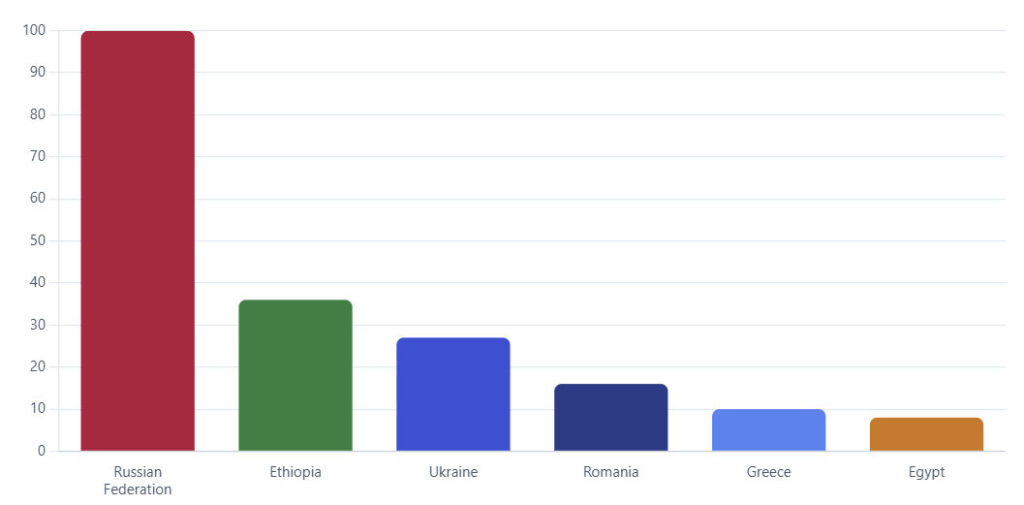
The North American diaspora provides a microcosm of global trends, specifically the divergence between Eastern and Oriental jurisdictions. According to the 2020 National Census of American Orthodox Christian Churches, the Eastern Orthodox community suffered a 17% decline in total adherents and a 14% decline in regular attendees between 2010 and 2020. [4] During the same period, the Oriental Orthodox community grew by 67% in total adherents and 54% in regular attendees. [4]
| Jurisdiction in the USA | 2020 Total Adherents | % Change (2010-2020) | Regular Attendees | % Regular Attendees |
|---|---|---|---|---|
| All Eastern Orthodox | 675,765 | -17% | 183,020 | 27% |
| Greek Orthodox Arch. | 376,000 | -22% | NA | NA |
| Orthodox Church in Amer. | 74,400 | -12% | NA | NA |
| All Oriental Orthodox | 491,413 | +67% | 171,045 | 35% |
| Coptic Orthodox | 180,000 | +95.6% | NA | NA |
| Ethiopian Orthodox | NA | +95.0% | NA | NA |
Source: [4]
The geographical concentration of US Orthodoxy remains tied to urban centers. Approximately 46% of all Orthodox adherents live in just five states: California (19.0%), New York (9.3%), New Jersey (6.8%), Florida (5.5%), and Illinois (5.4%). [15] At a more granular level, five counties (Los Angeles, Cook, Orange, Queens, and Middlesex) house nearly 18% of the entire US Orthodox population. [15] The growth in the Oriental sector is particularly visible in the establishment of new parishes; since 2010, 49% of Ethiopian Orthodox parishes and 43% of Coptic Orthodox parishes in the US are new foundations. [4] This “immigrant vitality” contrasts with the “generational attrition” observed in the Greek and Slavic jurisdictions, where traditional parish structures are struggling to retain younger, assimilated members. [4]
Orthodox Patriarchates often function as quasi-state actors, wielding significant influence over national legislation, education, and foreign policy. This is most evident in nations where the church is legally recognized as a “prevailing religion” or where constitutional agreements secure its financial status. [19]
The Georgian Orthodox Church (GOC) is widely regarded as the most influential institution in Georgian society, frequently outpacing the government in public trust polls. [20] The legal framework of this influence is the 2002 Constitutional Agreement (Concordat), which grants the GOC unique privileges, including exemptions from property and construction taxes that are not afforded to other religious groups. [23]
In 2024, the political instrumentalization of the GOC reached a new peak when the ruling Georgian Dream party proposed amending the constitution to declare Orthodox Christianity as the state religion. [24] This move was interpreted by human rights monitors as an attempt to leverage religious nationalism to bolster the party’s position ahead of parliamentary elections. [24] The church has also been a vocal supporter of the “Law on Transparency of Foreign Influence”, framing activities of Western-funded NGOs as a threat to traditional Georgian values and a “propaganda of the LGBT lifestyle”. [26] This alignment between church and state has significantly complicated Georgia’s European integration path, as the church uses its veto power to resist secularizing reforms required for EU membership. [26]
In Egypt, the Coptic Orthodox Church serves as the primary mediator between the Christian minority and the state. This relationship is characterized by what scholars term “sacralized citizenship”, where an individual’s rights and belonging are mediated through their religious affiliation. [28] Under Pope Tawadros II, the church has navigated a complex path of supporting the administration of President el-Sisi in exchange for legal protections and permits for church construction. [28]
The Coptic Church has transitioned from a purely spiritual body to a vital socio-economic actor, providing a “socio-political shelter” for a community that often feels marginalized in a system based on Islamic supremacy. [28] The church operates an extensive network of schools, hospitals, and vocational training centers that provide job security for Christians, particularly women and the disabled, who may face discrimination in the broader labor market. [28] In 2024, the church’s Papal Office for Projects (POP) successfully implemented 318 small income-generating projects and managed feeding initiatives for over 330,000 individuals. [31] This institutional influence ensures that the Patriarchate of Alexandria remains the indispensable representative of the Coptic population, though it has also led to the marginalization of lay voices who seek a more secular political representation. [28]
The economic influence of Orthodox Churches is derived from three primary sources: direct state funding, massive land and real estate holdings, and a growing portfolio of commercial assets. In Europe, the state-funding model remains dominant, while in the Middle East, real estate represents the core of the church’s financial power. [25]
In countries like Greece, Cyprus, and Georgia, the state remains the primary guarantor of church salaries. In Greece, despite a 2018 tentative deal to remove roughly 10,000 priests from the civil service payroll, the state continues to pay their salaries through a special annual fund estimated at $220 million. [35] This maintains the clergy’s status as quasi-public servants and ensures the church’s presence in every rural municipality.
Cyprus provides a highly transparent look at the mechanics of state support. Under a 2019 law, the state subsidy to the church covers the salaries of up to 850 priests. [32] This subsidy has grown consistently, reflecting cost-of-living adjustments and general salary increases for public servants. [32]
| Year | State Subsidy (Cyprus) | Source Agreement |
|---|---|---|
| 2022 | €7.2 million | Makarios III Era (1973/2019 revision) |
| 2023 | €7.6 million | 800 Eligible Priests |
| 2024 | €8.3 million | 850 Eligible Priests |
| 2025 | €8.8 million | Budgeted allocation |
| 2026 | €9.1 million | 0.5% annual increase in eligibility |
Source: [32]
In Georgia, the funding mechanism is even more expansive. Beyond the base statutory funding of 25 million GEL, the government frequently allocates tens of millions of additional GEL via executive decrees. In 2024, the total funding exceeded 67 million GEL, including 35 million GEL specifically earmarked for educational institutions under the Patriarchate’s control. [24] This funding is often funneled through the “Foundation for the Development of Education and Cultural Measures”, which received 22 million GEL of the 2024 educational allocation. [25] Critics point out that the Patriarchate is not required to provide transparency on how these public funds are spent, leading to concerns about political instrumentalization in election cycles. [25]
The Greek Orthodox Patriarchate of Jerusalem remains one of the largest non-governmental landholders in the State of Israel. Its holdings are so vast that major state institutions, including the Knesset, are built on land leased from the Patriarchate. [21] This portfolio, however, has become a source of intense conflict. In 2025, the Jerusalem municipality froze the Patriarchate’s bank accounts due to millions of shekels in unpaid property taxes on non-religious assets. [21] The Patriarchate argues that it has been exempt from such taxes under a status quo dating back to the Ottoman era, but the city has initiated “administrative enforcement proceedings” for assets not used as houses of worship. [21]
In a parallel development, the Armenian Patriarchate of Jerusalem has won significant legal victories in Turkey to recover confiscated properties. In October 2024, the “Mar Yakoup Foundation”, which represents the Patriarchate’s legal interests, gained legal personality in Turkey, reversing the “frozen” status of more than 1,000 real estate properties confiscated decades ago. [36] This recovery represents a massive potential infusion of assets for the Jerusalem Patriarchate, though its commercial exploitation remains a point of contention among the Armenian diaspora who fear the sale of ancestral lands to third parties. [37]
| Real Estate Issue | Jurisdiction | Key Metric/Status |
|---|---|---|
| Old City Leases | Armenian (Jerusalem) | 98-year lease on “Cows’ Garden” (Disputed) |
| Property Taxes | Greek (Jerusalem) | Millions in back-taxes demanded by municipality |
| Confiscated Assets | Armenian (Turkey) | 1,000+ properties in restitution process |
| Land Restitution | All (Romania) | Only 17.5% of 16,430 claims successful |
| Church Land | Cyprus | 15,564 hectares transferred to state for payroll |
Source: [21]
The Russian Orthodox Church (ROC) is widely cited as the world’s wealthiest Orthodox body, benefiting from a multi-billion ruble commercial empire. [34] This includes the “Sofrino” art and production enterprise, which has a near-monopoly on the production of church utensils, icons, and candles. [40] The church also operates the Danilovskaya Hotel in Moscow and the “Ritual Orthodox Service”. [40] In 2024, the ROC even approved principles for the use of artificial intelligence and launched its own messenger service, “Zosima”, reflecting a highly modernized approach to institutional assets. [40] However, the ROC’s financial health is increasingly tied to state support; it receives multimillion-dollar subsidies for the restoration of historic cathedrals and the maintenance of religious museums. [34] This dependency has ensured the church’s absolute loyalty to the Kremlin’s geopolitical agenda. [34]
The last decade has seen a historic rupture in the Orthodox world, as theological disputes over jurisdiction have been superseded by the realities of armed conflict. The primary catalyst for this shift was the granting of autocephaly (independence) to the Orthodox Church of Ukraine (OCU) by Ecumenical Patriarch Bartholomew of Constantinople in 2019, a move the Moscow Patriarchate characterized as a “schism”. [41]
The Russian invasion of Ukraine in 2022 transformed the jurisdictional rivalry into a matter of national security. The Ukrainian Orthodox Church of the Moscow Patriarchate (UOC-MP), once the largest religious body in the country, has seen its membership and public trust evaporate. According to Razumkov Center data from late 2024, only 5.5% of Ukrainians now identify with the UOC-MP, down from 13% in 2021. [11] Meanwhile, identification with the autocephalous OCU stood at 35.2% in 2024. [11]
The Ukrainian state has moved decisively against the UOC-MP, adopting Law No. 3894 in August 2024, which provides a legal mechanism to ban religious organizations linked to the Russian Orthodox Church. [11] As of November 2023, the government had opened 70 criminal investigations into UOC clergy for collaboration with the invader, leading to 19 convictions and the stripping of citizenship for several high-ranking priests. [44] The conflict has also resulted in the large-scale transfer of parishes; as of April 2023, 1,333 parishes and monasteries had moved from the UOC-MP to the OCU. [45] This shift is not merely ecclesiastical; it represents a fundamental re-orientation of Ukrainian society away from the “Russian World” ideology and toward a nationalized religious identity. [46]
| Identification in Ukraine | 2021 (%) | 2022 (%) | 2024 (%) |
|---|---|---|---|
| Orthodox Church of Ukraine (OCU) | 24% | 36% | 35.2% |
| Ukrainian Orthodox (Moscow Patr.) | 13% | 4% | 5.5% |
| “Just Orthodox” (Unaffiliated) | 22% | 14% | 14% |
| Support for Banning Russian Church | NA | NA | 74.3% |
Source: [11]
In retaliation for the Patriarchate of Alexandria’s recognition of the OCU, the Moscow Patriarchate established its own Patriarchal Exarchate of Africa in December 2021. [42] This move violated centuries of canonical tradition regarding territorial jurisdiction but has been immensely successful as a tool of soft power. Between 2022 and 2025, the ROC expanded from a single parish in South Africa to more than 350 parishes across 34 African countries. [48]
The expansion is driven by a strategy of “luring” local clergy from the Alexandrian Patriarchate with higher salaries, funding for church construction, and accelerated career paths. [48] Bloomberg reports that the ROC currently employs 270 African priests, many of whom previously served in Greek jurisdictions. [48] This religious growth is inextricably linked to broader Russian influence: seven “Russian Houses” (cultural centers) have opened since the war began, and the ROC often provides the ideological framework for anti-Western sentiment in the region. [48] In some instances, the church provides a “spiritual cover” for the activities of the “Africa Corps” (formerly Wagner Group), with church facilities serving as centers for promoting the “Russian World” to local elites. [42]
The Horn of Africa continues to be the most demographic robust region for Orthodoxy. The Ethiopian Orthodox Tewahedo Church (EOTC) is projected to eclipse the Russian Orthodox Church as the largest Orthodox body in the world by 2050. [5] This growth is fueled by an indigenous theology that has resisted Western individualistic modes of governance and education. [5] However, the EOTC faces internal threats from ethnic divisions and pressure from non-traditional Christian groups. In regions like Oromia, ethnicity often overrides religious identity, leading to splits within the Holy Synod and attacks on churches by radical ethnic groups. [51]
In the diaspora, the Coptic Church is arguably the most successful at institutional expansion. Since 1971, the Coptic Church has established over 150 churches across Africa, Europe, and the Americas. [53] In the United States, Coptic membership nearly doubled from 92,000 in 2010 to 180,000 in 2020. [16] This growth is maintained through a highly organic priestly vocation process, where members are chosen by their local parishes for ordination, ensuring deep community roots and financial sustainability. [16]
The current state of Orthodoxy is best understood through a comparison of institutional health metrics across the major families of the faith. While Eastern Orthodoxy possesses more absolute numbers and state support, the Oriental Orthodox family exhibits higher participation rates and more consistent growth in the diaspora.
| Metric | Eastern Orthodox (Europe) | Eastern Orthodox (Diaspora) | Oriental Orthodox (Africa) | Oriental Orthodox (Diaspora) |
|---|---|---|---|---|
| Membership Trend | Stagnant/Declining | Declining (-17%) | Rapid Growth | Rapid Growth (+67%) |
| Weekly Attendance | Low (6-15%) | Moderate (27%) | Very High | High (35%) |
| State Funding | High (Greece/Georgia) | Low (Self-Funded) | Moderate (Privileged) | Low (Self-Funded) |
| Geopolitical Role | State Ideology (Russia) | Cultural Minority | National Identity | Social Service Provider |
| Parish Growth | Slow | Declining | Very Fast | Fast (40%+ New) |
Source: [3]
The global Orthodox landscape in 2026 is defined by a paradox of institutional wealth and demographic fragility. The Eastern Orthodox communion, long dominated by its European centers, is currently suffering from a deep internal schism and the fallout of the Russia-Ukraine war. The Moscow Patriarchate’s pivot to Africa and its integration into the Kremlin’s geopolitical engine have fractured the “conciliarity” that once defined the faith. In contrast, the Oriental Orthodox tradition, specifically in Ethiopia and the Coptic diaspora, is emerging as a more vibrant, observant, and demographically resilient pole of the faith.
The economic data suggests that the era of unquestioned state support may be coming to an end, as governments in Greece and Cyprus seek to decouple clergy from the civil service, and Jerusalem’s municipality challenges the church’s tax-exempt status. Future stability will likely depend on the church’s ability to manage its massive real estate portfolios and adapt to the needs of its growing Global South populations. As the “Old World” of Slavic and Greek Orthodoxy grapples with secularization and conflict, the “New World” of Ethiopian and Coptic Orthodoxy is setting the pace for the faith’s 21st-century survival. The transition from a Euro-centric tradition to a truly global communion is no longer a projection; it is a current, data-driven reality.


I am an entrepreneur who found faith through the trials of life. I don’t claim to be a theologian or a 'perfect' Christian; I am a seeker who discovered that Jesus’s strength is best revealed in our moments of weakness.
I write these articles to share the spiritual keys that helped me, and my team at JesusBYS, find hope and resilience. Today, alongside a dedicated collective of creators and professionals, we work to make Jesus’s timeless wisdom accessible to everyone navigating the challenges of the modern world.
© 2026 JesusBYS. Operated by Ananasova Loves You OÜ. All rights reserved. | Legal Notice | Privacy Policy | Terms of Service
This website is protected by reCAPTCHA and the Google Privacy Policy and Terms of Service apply.