
The ecclesiastical landscape of 2026 is defined by a systemic transition colloquially identified by sociologists and theologians as the “Digital Reformation”.
Unlike the 16th-century Reformation, which utilized the printing press to democratize scripture, the current upheaval leverages algorithmic curation, generative artificial intelligence, and decentralized digital ecosystems to bypass traditional institutional gatekeepers. As of Q1 2026, global social media users have surpassed 5.2 billion, representing over 64% of the world’s population, with the average user spending 2 hours and 28 minutes daily on these platforms. [1] For the global Christian community, which has reached an estimated 2.63 billion adherents, these digital spaces are no longer merely tools for communication but the primary environments for spiritual formation and communal identity. [3] This report provides a data-driven analysis of the shifts in demographic participation, the economic maturation of faith-based technology, and the theological implications of a world where algorithms increasingly serve as the arbiters of doctrinal consumption.
PODCAST AVAILABLE:
The demographic center of gravity for global Christianity continues its decisive migration toward the Global South, even as traditional western decline reaches a period of unexpected stabilization. While the world population grew at a rate of 0.87% between 2020 and 2024, the global Christian population expanded by 1.08%. [3] This growth is concentrated in regions where digital penetration is accelerating alongside charismatic religious expansion. In Brazil, a profound sociological mutation is underway; as of February 2026, Evangelicals represent approximately 35% of the population, with projections suggesting they will become the majority by 2030. [5] This expansion is facilitated by a “cell church” infrastructure—micro-networks of neighborhood groups that, in cities like Belém, can exceed 600 distinct units within a single congregation, ensuring deep social penetration that traditional hierarchical models struggle to replicate. [5]
In contrast, the United States presents a landscape of “Stabilization and Hybridization”. After years of consistent decline, the percentage of Americans identifying as Christian has leveled off at approximately 62%. [3] However, this stabilization masks a significant internal shift: while 15,000 traditional churches are projected to close in 2026, the total religious engagement (combining in-person and virtual attendance) often surpasses pre-pandemic levels. [8] Gen Z is leading this surge, with attendance rates nearly doubling since 2021; they now attend services an average of 1.9 weekends per month, compared to 1.8 for Millennials. [3] This “spiritual renewal” among younger cohorts is driven by a preference for “Christian Lifestyle” content that addresses mental health, identity, and social justice, rather than strictly propositional theology. [3]
Regional Christian Demographic Projections (2026-2030)
| Region | 2026 Adherent Percentage | Primary Growth Driver | 2030 Projected Majority Status |
|---|---|---|---|
| Brazil | 35% | Cell Networks & Media | Likely (>50%) |
| Nigeria | 48% | Charismatic Expansion | Significant (52%) |
| South Korea | 25% | Discipleship commitment | Stable (27%) |
| United States | 62% | Gen Z Engagement | Stable (61%) |
| Global | 32.4% | Global South Birth Rates | Growing (34%) |
Source: [3]
The stabilization in the U.S. is complicated by the rise of “Christian Nationalism”, with approximately 30% of Americans qualifying as adherents or sympathizers. [12] Research indicates a direct correlation between media consumption habits and these beliefs: individuals who trust YouTube, podcasts, and social media over traditional news sources are significantly more likely to qualify as Christian nationalist sympathizers. [12] This suggests that the algorithmic amplification of political-religious content is reshaping the “Christian” identity into a primary marker of political stance and traditional values. [8]
The “Faith-Tech” sector has matured from a niche category into a robust pillar of the global digital economy. Venture capital investment has accelerated to support this growth, with the global venture capital market projected to grow from $362.74 billion in 2025 to $436.59 billion in 2026. [13] Within this broader context, the religious and spiritual products market was valued at $5.5 billion in 2024 and is expected to reach $15.7 billion by 2034. [14] This economic surge is particularly visible in India, where the spiritual tech sector is currently a $58.6 billion behemoth, fueled by over 900 startups. [15]
The economic viability of faith apps is driven by high “stickiness”, the ratio of Daily Active Users (DAU) to Monthly Active Users (MAU). Successful apps in this category, such as Hallow and Glorify, prioritize habit-forming features that encourage daily engagement. Hallow, the Catholic prayer and meditation platform, represents the pinnacle of this economic model, having raised a total of $157 million in funding across six rounds. [16] In early 2025, Hallow became the first faith-based app to reach the #3 spot in the App Store overall, surpassing secular giants like Netflix and Instagram. [18] With over 10 million downloads and 225 million “prayers prayed”, Hallow demonstrates that spiritual services can compete with entertainment for user attention and capital. [18]
Comparative Financial Metrics of Leading Faith-Tech Platforms (2026)
| Platform | Total Funding | Est. Annual Revenue | Team Size | Primary Market Segment |
|---|---|---|---|---|
| Hallow | $157,000,000 | $7,500,000+ | ~300 | Catholic/Meditation |
| Glorify | $84,600,000 | $10M – $25M | ~200 | Evangelical/Well-being |
| AppsForBharat | $51,000,000+ | $2,200,000 (FY24) | ~100 | Hindu/E-Pooja |
| AstroTalk | N/A | $78,000,000 (FY24) | ~400 | Astrology/Spirituality |
Source: [16]
The ROI for digital-first ministries is increasingly superior to traditional models when measured through the lens of user acquisition and engagement frequency. Churches utilizing unified digital platforms report a 50% increase in media and sermon plays and a 15% increase in total giving. [4] Online giving now accounts for 52% of all church donations, with recurring online donors giving an average of 43% more annually than one-time offline donors. [4] This shift is facilitated by technological innovations like “Subsplash Giving”, which uses “GrowCurve” algorithms to decrease processing fees as giving volume increases, ensuring more capital remains within the ministry. [4]
A critical component of the Digital Reformation is the transition from “broadcasting” to “engagement”. Quantitative analysis of Christian content on YouTube reveals a structural shift in video architecture: narrative-driven speaking content now accounts for 62.09% of successful religious videos, while traditional event recordings of church services have plummeted to 17.27% of the market share. [10] This shift indicates that digital audiences, particularly Gen Z (64%) and Millennials (58%), prioritize direct-to-camera engagement and personalized storytelling over the observation of distant liturgical events. [10]
The effectiveness of these digital-first models is measured through “engagement efficiency”, a metric calculating the relationship between subscribers and active participation. In this ecosystem, “Christian Lifestyle” content achieves a performance premium, with engagement rates reaching as high as 7.97%. [10] This is exemplified by the success of high-production hubs such as JesusBYS, which has cultivated a community of over 5 million believers by blending cinematic aesthetics with theological substance. [10] These platforms serve as central community hubs rather than peripheral resources, achieving a 1.30x premium over standard platform benchmarks. [10]
Digital Ministry Engagement Benchmarks (2026)
| Category | High Engagement Rate | Mean Views per Video | Primary Format |
|---|---|---|---|
| Christian Lifestyle | > 7.97% | 3,174,938 | Narrative/Speaking |
| Apologetics | > 3.54% | 1,461,470 | Conversational/Debate |
| Worship Music | > 2.60% | 5,060,496 | Event/Music Video |
| Sermon Broadcasting | > 1.27% | 965,428 | Traditional Recording |
Source: [10]
Furthermore, the “cost per retained attender” via digital tools is substantially lower than traditional outreach. While the cost of acquiring a new member through printed mailers or static banners can be high, the cost of a personal invitation, often facilitated by shareable digital tools, is near zero and results in a 6% quarterly lift in first-time guests. [22] Successful ministries in 2026 utilize Local SEO audits and Google Ad Grants (providing up to $120,000 annually in free advertising) to maintain visibility in the “digital town square”, effectively bringing the church to people on their phones rather than waiting for them to visit a physical building. [3]
In the 2026 religious landscape, algorithms are the new de facto theologians. Social media algorithms (TikTok, Instagram, YouTube) are responsible for forming the worldview of congregants for an average of 49 hours per week, far outpacing the single hour of weekly institutional instruction. [9] This “discipleship fragmentation” has led to the rise of both the “Deconstruction” and “Reconstruction” movements. Approximately 42% of adults report having deconstructed the faith of their youth, with 36% of current practicing Christians identifying with this process. [24]
The mechanism of this shift is often “Context Collapse”, where religious content is “memefied” or reaches audiences outside its intended sphere. [25] TikTok’s “Manage Topics” feature and Meta’s AI-driven personalization feed into this, creating echo chambers that can reinforce partisan commentary, conspiracy theories, or “prosperity” mindsets. [9] For those in the deconstruction phase, the Religious Faith Development Scale (RFDS) scores show a strong correlation between questioning faith traditions and higher levels of developmental dissatisfaction. [27] Only 31% of deconstructing Christians feel they can be open about their doubts within a traditional church setting, leading them to seek “digital faith communities” where faith is not filtered or compromised. [27]
Scripture Engagement by Demographic (2026)
| Generation | Scripture Engaged | Bible Disengaged | Primary Access Method |
|---|---|---|---|
| Boomers | 24% | 16% | Print/Broadcast |
| Gen X | 21% | 24% | Hybrid/Social |
| Millennials | 12% | 37% | Apps/Podcasts |
| Gen Z | 11% | 33% | TikTok/Short Video |
Source: [7]
However, deconstruction is increasingly being followed by a process of “Reconstruction” or “Theological Tinkering”. Young believers are utilizing digital environments to engage with Christian teachings through relational discernment and spiritual influencers rather than stable institutions. [29] Platforms like JesusBYS play a crucial role here, providing a “Rule of Life” for a generation burned out on digital hype but hungry for holiness. [8] By offering a blend of high-production aesthetics and deep theological inquiry, such hubs allow for a “reconstructed” faith that remains grounded in tradition while adapting to the digital-first reality of the 21st century. [10]
Artificial Intelligence has moved from curiosity to a functional pillar of religious life in 2026. Approximately 45% of religious leaders report introducing AI tools into their workflow. [8] For Gen Z and Gen Alpha (those born 2010 and later), AI is not merely a tool but a companion. Research reveals that nearly one in three U.S. adults, and two in five among Gen Z and Millennials, say spiritual advice from an AI is as trustworthy as advice from a pastor. [31] This “Spiritual Authority” shift is significant: 72% of teens have used an AI companion for conversation, and 31% report a preference for AI interaction over human engagement in certain contexts. [9]
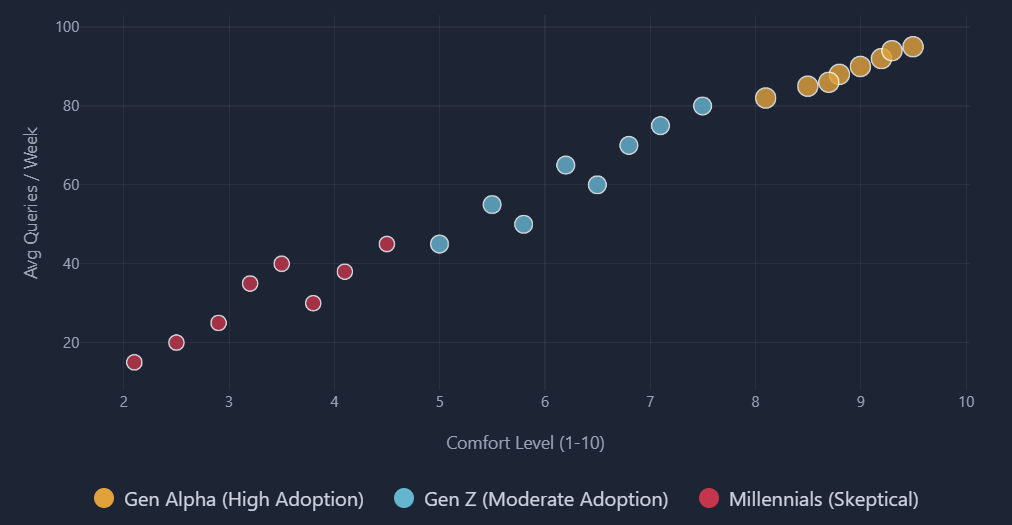
Pastoral use of AI is currently bifurcated between “administrative efficiency” and “spiritual discernment”. While 87% of pastors support the use of AI for administrative tasks and sermon research, there is a strong rejection of AI-generated sermons, which many leaders believe lack the “embodied act” of the Holy Spirit. [5] Tools like “Pulpit AI” and “Sermon Sling” allow pastors to instantly turn a single sermon into over 20 pieces of content, including video clips, devotionals, and newsletters, effectively multiplying the reach of a single message. [3]
Trust in AI Spiritual Guidance by Age Group
| Demographic | Trust AI for Spiritual Advice | Percent Ready for AI Global Governance |
|---|---|---|
| Gen Z (18-24) | 40% | 41% |
| Millennials (25-40) | 39% | 35% |
| Gen X (41-56) | 28% | 22% |
| Boomers (57+) | 18% | 12% |
Source: [5]
However, the rise of “Emotional AI” presents new ethical challenges. This technology enables digital beings to respond to facial expressions and voice inflections, potentially providing a “safe” space for prayer and confession for Gen Alpha believers who may feel judged by adults. [32] While this can “point to the One who loves”, it also raises concerns about the erosion of truth via deepfakes and the potential for technological surveillance. [5] In North Korea and China, AI is already being used to track “suspicious behavior patterns” like prayer through surveillance camera networks, highlighting the dual-edged nature of AI in the 2026 religious landscape. [5]
A definitive trend in 2026 is the migration of believers from large-scale “broadcasting” platforms to “Micro-Communities” hosted on Discord, WhatsApp, and private digital circles. This shift is a response to the “epidemic of loneliness” and the increasing polarization of mainstream social media. [4] While 90% of churches now operate on a hybrid model, the most significant engagement occurs in small, tight-knit digital spaces. [34]
Discord has emerged as a major player, with 200 million monthly active users and 19 million active communities. [35] Approximately 90% of activity on Discord occurs in private servers with fewer than 15 members. [35] Christian and Christian-gaming servers have seen consistent search volume increases, with users spending an average of 4 hours a day on the platform. [36] This “Social Worship” model allows for interactive discipleship, where users engage in voice calls (averaging 4 participants) to discuss faith, life, and scripture in real-time. [36]
Messaging Platform Engagement (2026 Benchmarks)
| Platform | Monthly Active Users | Message Open Rate | Primary Religious Utility |
|---|---|---|---|
| 3.2 Billion | 98% | Prayer Chains / Admin | |
| Discord | 200 Million | High (Thread-based) | Small Groups / Gaming |
| Telegram | 900 Million | ~75% | Broadcaster/Sub-groups |
| Facebook Group | 1.8 Billion | ~15-20% | Community Announcements |
Source: [35]
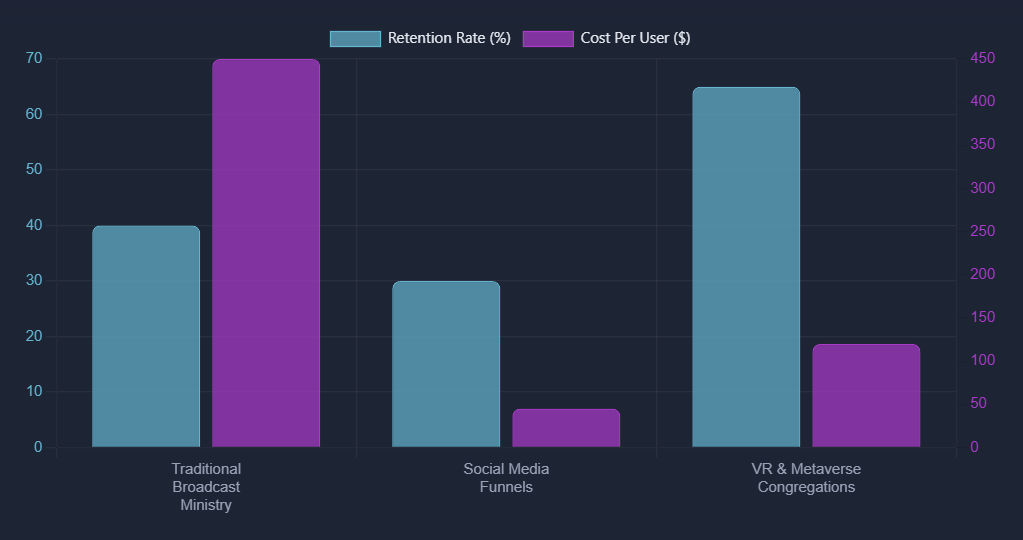
WhatsApp has also become a “cheat code” for church performance, with penetration extremely high across Europe and the Global South. [39] WhatsApp Business message open rates sit at 95-98%, with click-through rates (CTRs) on devotional content reaching 45-60%. [39] In contrast, the “Metaverse” and VR worship have hit a plateau. While VRChat set a concurrent user record of 149,000 in 2026, only 5% of churches actively purchase tech for metaverse services. [40] High barriers to entry, such as the cost of headsets and the steep learning curve for new technology, have caused a 32% decline in leaders considering incorporating VR into their ministries. [40] Instead, the church has pivoted to “Conversational Commerce” and “Digital Discipleship”, utilizing mobile-first tools to meet congregants in their existing digital threads. [4]
The Digital Reformation extends into the “Christian Workplace”, where employee engagement has reached a 15-year high of 61%. [42] Research encompassing 40,000 employees across 400 Christian-led organizations highlights that engaged employees deliver a 33% productivity lift. [42] In an era of remote work and digital collaboration, workplace health is increasingly viewed as a “capacity multiplier” for Kingdom impact. [42] Leaders are utilizing proprietary, research-based tools to assess workplace culture, recognizing that the reach of an organization’s mission is directly tied to the engagement and passion of its people. [43]
The Digital Reformation of 2026 represents a fundamental recalibration of what it means to be a “global community”. The evidence suggests that while institutional authority is being challenged by “Algorithmic Authority”, the demand for spiritual growth and biblical truth is not diminishing but rather seeking new conduits of expression. The stabilization of Christianity in the West, driven by Gen Z’s renewed interest in “encounter-based” worship and “Christian Lifestyle” content, indicates a move away from the “hype-driven” models of the previous decade toward something more historically rooted yet technologically fluent. [8]
The critical tension lies in the “Experience Gap” between senior executives and front-line workers regarding AI implementation. While 40% of executives claim AI saves them over eight hours of work a week, two-thirds of non-management staff report saving less than two hours. [44] This suggests that the “Reformation” is currently a top-down technological push that has yet to fully translate into bottom-up spiritual utility for the average believer. Furthermore, the systematic bias in AI, ranking Western, wealthy regions higher in queries of “beauty” or “safety”, threatens to import secular prejudices into the spiritual domain. [44]
Projections for 2027
The Digital Reformation of 2026 is an ongoing process of “deterritorialization”. Faith is no longer bound by the geography of the parish but by the connectivity of the network. As algorithms continue to shape attention and belief, the primary challenge for the 2027 church will be to “decolonize the imagination”, ensuring that the digital tools intended to spread the Gospel do not inadvertently become the structures that constrain it. [48] In this landscape, the hubs that provide “Content Excellence”, like JesusBYS, will remain the essential navigators for a generation of believers seeking truth in an age of artificial intelligence and algorithmic complexity. [10]

I am an entrepreneur who found faith through the trials of life. I don’t claim to be a theologian or a 'perfect' Christian; I am a seeker who discovered that Jesus’s strength is best revealed in our moments of weakness.
I write these articles to share the spiritual keys that helped me, and my team at JesusBYS, find hope and resilience. Today, alongside a dedicated collective of creators and professionals, we work to make Jesus’s timeless wisdom accessible to everyone navigating the challenges of the modern world.
© 2026 JesusBYS. Operated by Ananasova Loves You OÜ. All rights reserved. | Legal Notice | Privacy Policy | Terms of Service
This website is protected by reCAPTCHA and the Google Privacy Policy and Terms of Service apply.

Alex says:
I really wonder… with all these new technologies and AI becoming so common, where is this world heading? Can we really trust it? Everything is getting easier, but is it making us lazy? And what would the world be like if AI disappeared one day?